
4130 Bicycle Tubing
A steel bicycle frame is assembled from a small set of tubes, each with its own job and its own customary size. 4130 has been the standard frame-building steel for decades.
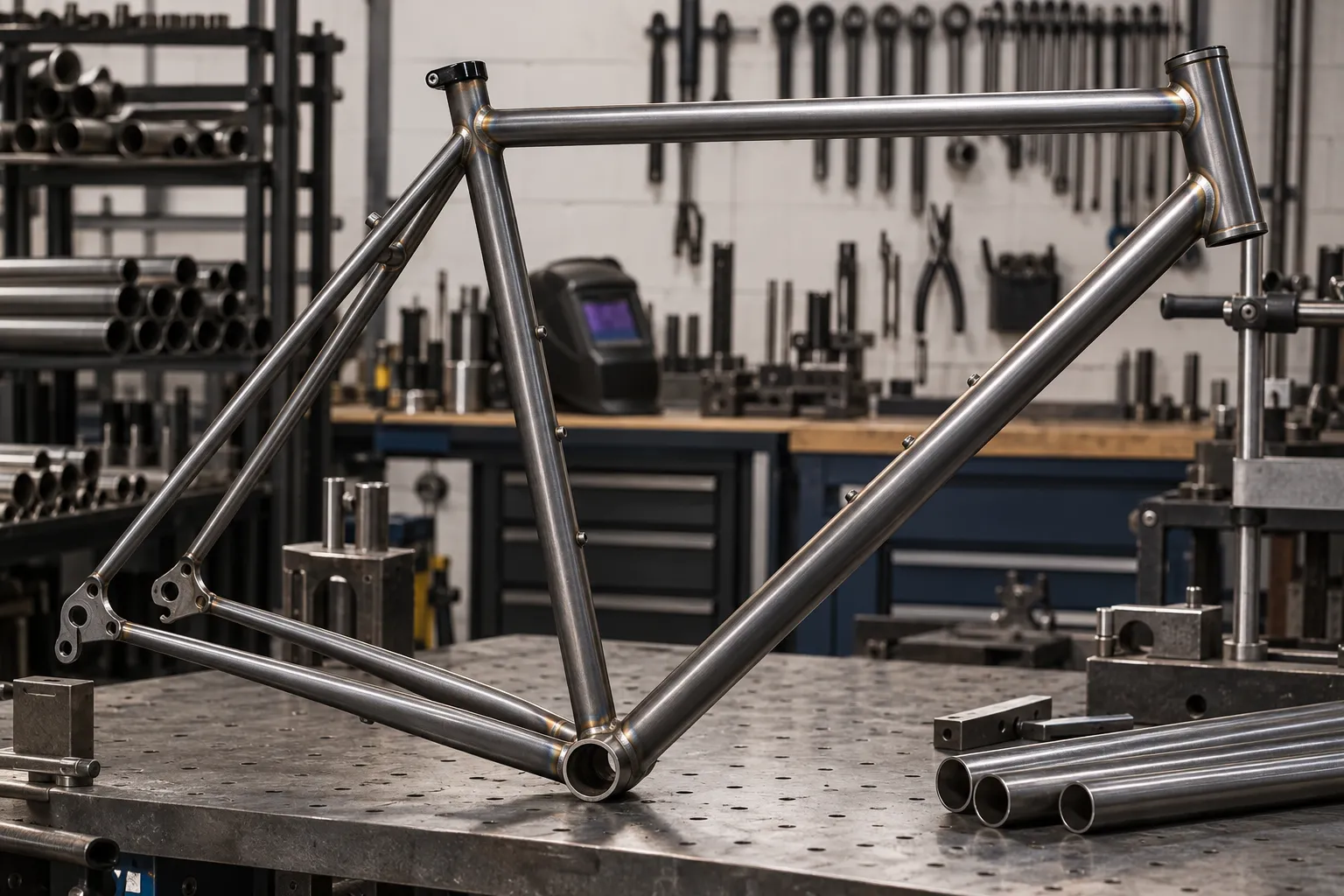
Bicycle Frame Tube Selection
Bicycle frame tube selection balances OD (which governs stiffness for a given wall), wall thickness (which governs weight and strength), and the tube geometry of each member. Main triangle tubes (top tube, down tube, seat tube) handle primarily bending and compression loads. Chainstays and seatstays primarily see bending and axial loads from pedalling forces. Different tubes in the same frame are often different sizes and wall thicknesses for optimal weight efficiency.
Butted Tubing
High-quality 4130 bicycle frame tubing is often 'butted' — the tube wall is thicker at the ends (where the maximum stress occurs at the tube joint) and thinner in the middle (where lower stress allows weight reduction). Double-butted tubing has thick walls at both ends and thin in the middle. Triple-butted has three different wall thicknesses. Butted tubing is a specialist product distinct from standard CDS mechanical tubing with uniform wall.
For frame builders using standard CDS 4130 mechanical tubing, the uniform-wall product is used with good results, particularly for production work or where butted tube lead times and minimums are impractical.
| Tube Type | Wall Profile | Application |
|---|---|---|
| Straight-gauge (uniform wall) | Consistent OD and wall throughout | Standard commercial supply — available as CDS |
| Double-butted (DB) | Thick ends, thin mid-section | Specialist frame tubing — weight optimised |
| Triple-butted (TB) | Three different wall sections | High-end frame tubing — maximum weight saving |
| Note | Butted tubing requires specific frame tube suppliers | Not standard CDS mechanical tubing product |
The Tubes in a Frame Set
| Tube | Traditional diameter | Oversize diameter |
|---|---|---|
| Top tube | 25.4 mm (1") | 28.6 mm (1-1/8") |
| Down tube | 28.6 mm (1-1/8") | 31.8 mm (1-1/4") and larger |
| Seat tube | 28.6 mm (1-1/8") | 28.6 to 31.8 mm |
| Head tube | 31.8 mm (1-1/4") | 36 mm and larger |
| Chain stays | About 22 mm, tapered | Similar, often shaped |
| Seat stays | About 14 to 16 mm | Similar |
Oversize tubes are stiffer for their weight, which is why modern steel frames use them with thinner walls. Stays are usually tapered or bent to clear the wheel and tyre, so they are often bought as purpose-made frame parts.
Straight-gauge 4130 in these diameters suits touring, cargo, BMX and utility frames and is a good material to learn on. State the diameter and wall for each tube and the length you need. Building considerations are covered under 4130 tubing for bicycle frames; thin walls under thin wall tubing.
Frequently Asked Questions
Is standard ASTM A519 CDS 4130 acceptable for bicycle frame construction?
Yes. Many quality steel frames are built from standard uniform-wall CDS 4130 tube. The butted frame tubing available from specialist bicycle tube suppliers (e.g., Reynolds, Columbus) provides weight savings but is a specialist product. For prototypes, custom builds, or builders who cannot access minimum quantities of butted tube, standard CDS 4130 is a legitimate alternative.
What OD is typically used for a bicycle main triangle?
Typical road and mountain bike frame tubes use ODs in the 28mm–38mm range (approximately 1.1"–1.5"). Exact sizing depends on frame design, rider load, and the builder's structural analysis. This is general guidance — verify with your frame design calculations.
Why do modern steel bikes use oversize tubes?
A larger diameter is stiffer for the same weight, allowing thinner walls.
Source 4130 Bicycle Frame Tubing
Provide your required tube sizes (OD and wall), frame count or footage, and condition for a frame tubing quotation.
- OD & Wall per tube member
- Total footage per size
- Condition (as-drawn preferred for most frame building)
- MTC requirement
- Delivery