
4130 Tubing Mechanical Properties
The mechanical properties of 4130 tubing are not a single set of numbers. They shift with heat treatment condition, with the amount of cold work and with wall thickness, which is why two certificates for the same grade can show different strengths.
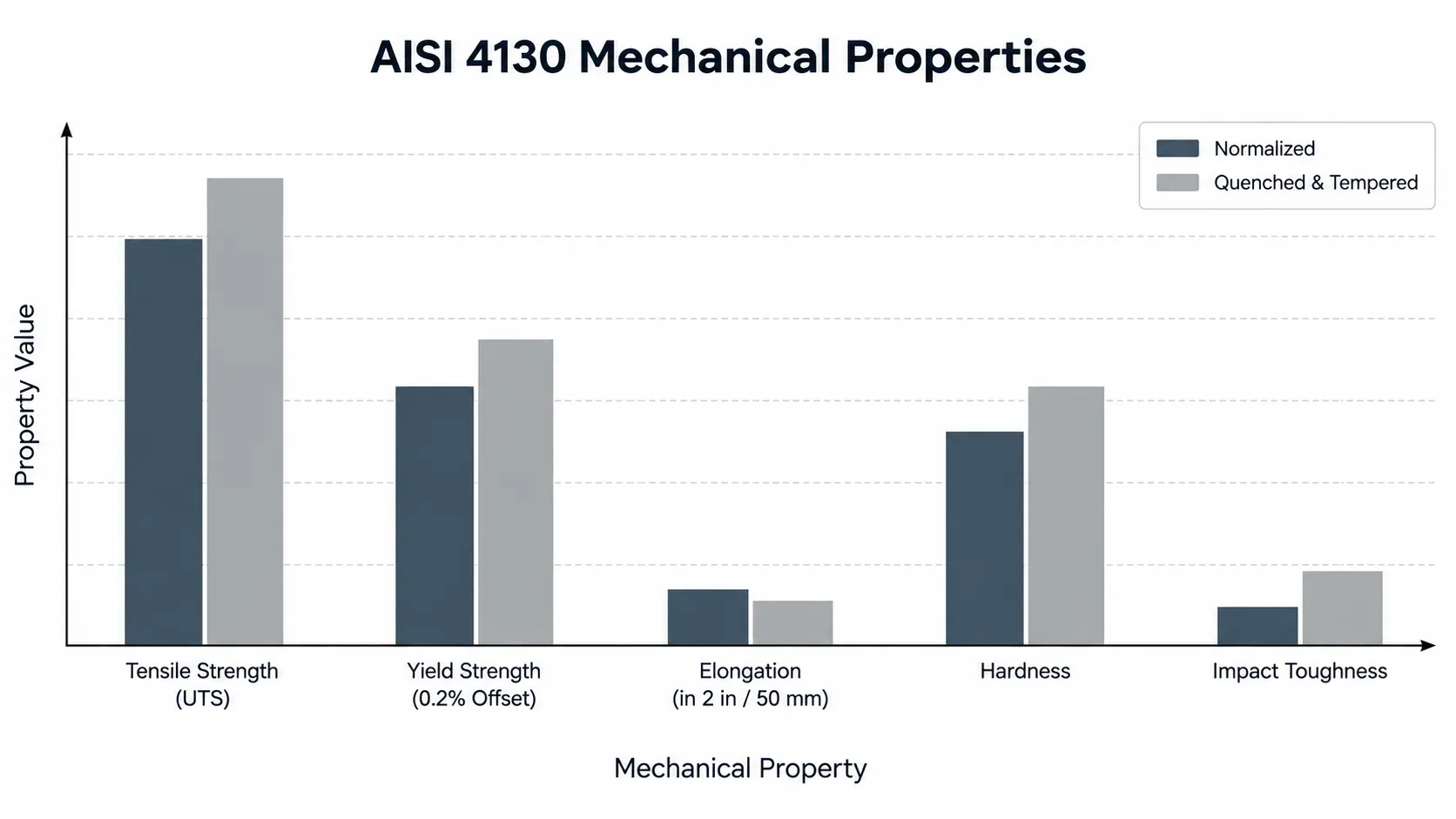
Key Mechanical Definitions
- Yield Strength: The stress point at which the tube begins to deform plastically (permanently). This is the critical number for structural chassis design.
- Ultimate Tensile Strength (UTS): The maximum stress the material can withstand before breaking.
- Elongation: A measure of ductility; how much the material stretches before fracture.
Reference Properties by Condition
The values below are *general approximations* for reference to show how conditions alter properties. Do not use these for engineering calculations. Always use the minimums defined by your design standard.
| Condition | Approx. Yield Strength | Approx. Tensile Strength | Characteristics |
|---|---|---|---|
| Annealed | 60,000 PSI | 80,000 PSI | Soft, highly ductile, easy to bend |
| Normalized | 75,000 - 90,000 PSI | 95,000 - 110,000 PSI | Standard structural baseline |
| As-Drawn (Cold Worked) | 80,000 - 95,000+ PSI | 100,000 - 115,000+ PSI | Harder due to cold work, lower ductility |
| Quenched & Tempered | 100,000 - 150,000+ PSI | 120,000 - 170,000+ PSI | Highest strength, depends on temper |
| Note | Consult MTC or Standard for actual design minimums. |
What Changes the Properties
- Condition. Annealed is weakest and most ductile; normalized is stronger; quenched and tempered is strongest.
- Cold work. Drawing raises strength and lowers ductility until the tube is heat treated.
- Wall thickness. Thin sections cool faster and can finish slightly stronger after normalizing.
- Welding. The zone beside a weld has different properties from the parent tube.
One property does not change: stiffness. The elastic modulus of 4130 is about 29 to 30 million psi (roughly 205 GPa), the same as mild steel, whatever the condition. A 4130 tube is stronger than a mild steel tube of the same size but not stiffer.
For conversion, 1 ksi equals 6.895 MPa, so 100 ksi is about 690 MPa. To know the properties of your tube, order it with a tension test and read the results on the certificate. Typical figures by condition are tabulated under ASTM A519 Grade 4130; the conditions themselves in the heat treatment guide.
Frequently Asked Questions
Will the MTC show the exact mechanical properties of my tubing?
If mechanical testing was specified on the order (or mandated by the standard, like AMS-T-6736), the MTC will show the actual tested Yield, Tensile, and Elongation values for that specific heat lot.
Is 4130 stiffer than mild steel?
No. Both have the same elastic modulus. 4130 is stronger, not stiffer.
How do I convert ksi to MPa?
Multiply by 6.895.
Does welding change the strength of 4130 tubing?
Yes. The zone beside the weld differs from the parent tube, which is why joint design and procedure matter.
Request Material with Verified Properties
We provide MTC 3.1 documentation to verify mechanical properties. State your required standard and condition.
- Standard (ASTM/AMS)
- Condition
- OD & Wall
- MTC with Mechanicals Required