
4130 Aircraft Tubing
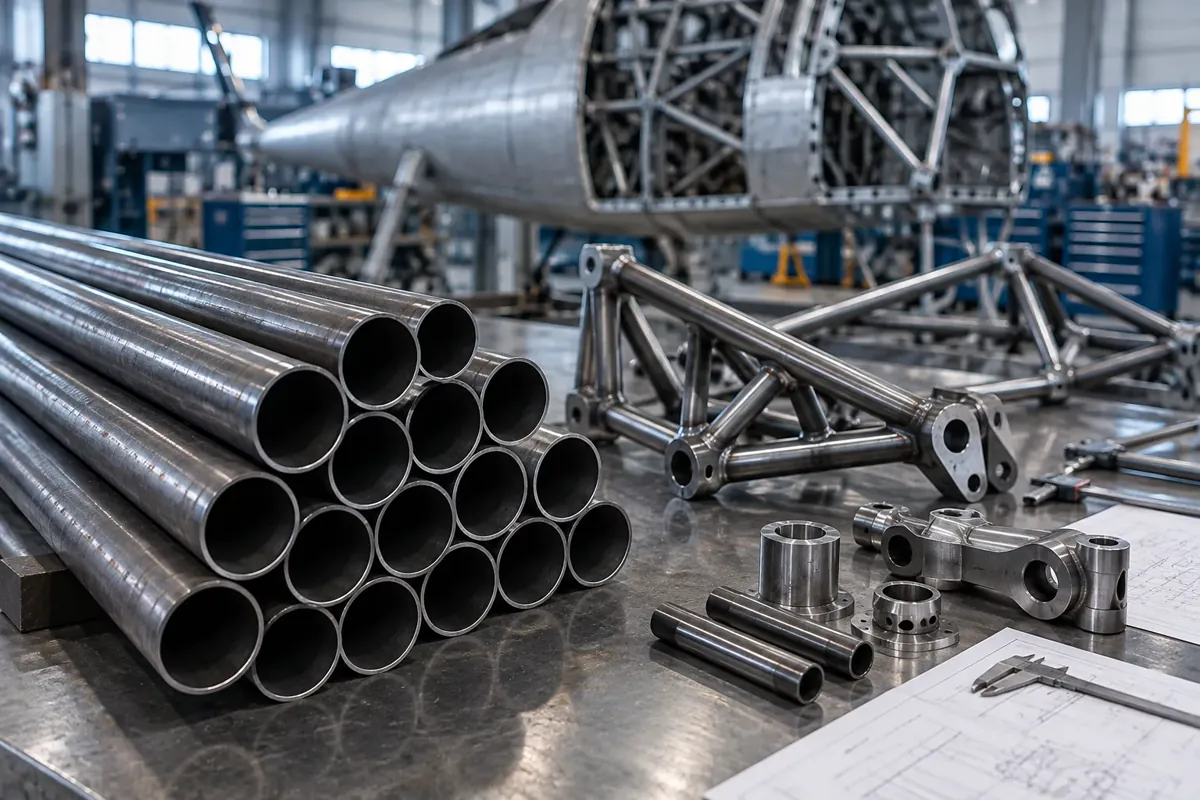
Welded 4130 steel tube has formed the backbone of light aircraft since the 1930s. It remains the standard material for fuselage trusses, engine mounts and landing gear on many certified and homebuilt designs.
AMS-T-6736 — The Aircraft Structural Tubing Standard
For FAA-certificated aircraft, the primary material specification for 4130 structural tubing is AMS-T-6736 (formerly MIL-T-6736). This standard mandates:
- Grade: 4130 chromium-molybdenum steel
- Condition: Normalized (Condition N)
- Form: Seamless
- Dimensional tolerances: Defined within the standard
- Testing: Chemical analysis, mechanical properties
AMS-T-6736 imposes requirements beyond standard ASTM A519 mechanical tubing, including the normalized condition requirement and specific mechanical property ranges. Buyers sourcing 4130 for FAA-certificated repair, replacement, or new construction must verify that the tubing meets AMS-T-6736 and that the MTC confirms compliance.
Experimental Aircraft
For FAA Experimental Amateur-Built (EAB) aircraft, the material requirements are determined by the builder and the type design (if following an existing design). Many EAB designs specify 4130 CDS to ASTM A519 rather than AMS-T-6736. The builder-PIC is responsible for determining the appropriate specification for their design category and must document the material used.
| Parameter | 4130 Aircraft Tubing (AMS-T-6736) |
|---|---|
| Standard | AMS-T-6736 (formerly MIL-T-6736) |
| Grade | 4130 Cr-Mo alloy |
| Condition | Normalized (Condition N) |
| Form | Seamless |
| FAA certification | Appropriate for certificated aircraft structural applications |
| EAB aircraft | May use ASTM A519 — builder determines appropriate spec |
| Documentation | MTC confirming AMS-T-6736 compliance with normalized condition |
| OD range (verified) | 0.25 in – 5.0 in |
| Wall range (verified) | 0.035 in – 0.500 in |
Where 4130 Tube Is Used in an Airframe
| Structure | Role of the tube |
|---|---|
| Fuselage truss | Longerons, uprights and diagonals forming the main structure |
| Engine mount | Carries thrust, torque and engine weight to the firewall |
| Landing gear | Legs, struts and bracing |
| Tail surfaces | Spars, ribs and frames of fin, rudder, stabiliser and elevator |
| Wing struts and fittings | External bracing and attachment points |
| Control system | Pushrods and torque tubes |
These structures use many small, thin-walled tubes in the normalized condition. The specification matters: certified aircraft and approved repairs require material to the aircraft standard named in the design data, with the matching certification. Homebuilders have more freedom but should follow the designer's material list.
When ordering, give the specification, OD, wall and condition for each size. Sizes and telescoping fits are explained in the aircraft tubing size guide; the structural use of the tube under 4130 tubing for aircraft frames.
Frequently Asked Questions
Must I use AMS-T-6736 for all aircraft 4130 tubing?
For FAA-certificated aircraft structural applications, yes — the applicable maintenance/repair standards (e.g., AC 43.13-1B) direct the use of AMS-T-6736 or its equivalent. For experimental aircraft, the builder determines the specification. Verify requirements with the applicable authority or designer.
Is normalized condition always required for aircraft 4130?
AMS-T-6736 specifically requires the normalized condition. Annealed or as-drawn 4130 does not meet AMS-T-6736 requirements. The MTC must explicitly state 'Condition N' or 'Normalized' to confirm compliance.
Which parts of a light aircraft are made from 4130 tube?
Typically the fuselage truss, engine mount, landing gear, tail surfaces and control tubes.
Source 4130 Aircraft Tubing to AMS-T-6736
Specify AMS-T-6736, Condition N, OD, wall, footage, and MTC requirement for an aircraft tubing quotation.
- Standard: AMS-T-6736
- Condition: Normalized (N)
- OD & Wall
- Total Footage
- MTC confirming AMS-T-6736 compliance
- Delivery