
4130 Tubing for Bicycle Frames
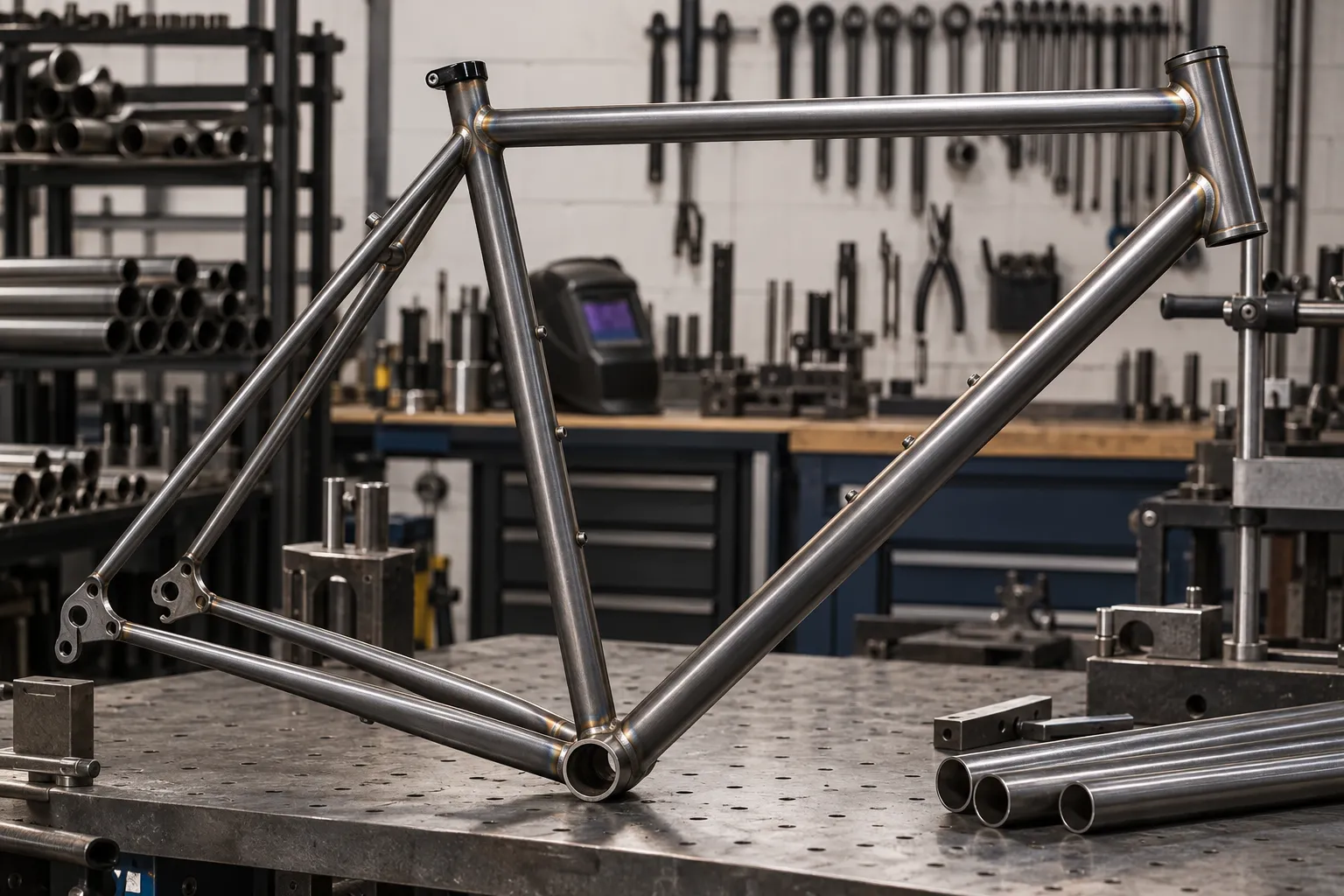
Building a bicycle frame in 4130 is precise work with thin tube. The quality of the mitres and the control of heat decide how the frame rides and how long it lasts.
Material Comparison — 4130 vs. Aluminium vs. Carbon
Frame builders choosing 4130 over aluminium benefit from: easier weld repair (a cracked 4130 frame can be re-welded; a cracked aluminium frame typically cannot), higher elongation (greater plastic deformation before fracture), and the ability to use thinner-wall butted tube without the stress-riser effects that can affect aluminium at join areas.
Carbon fibre frames cannot be field-repaired; they require manufacturer involvement. 4130 frames can be repaired by any competent frame builder with a TIG welder.
Tube Selection for Bicycle Frames
For standard-geometry road, gravel, and mountain bike frames using 4130, typical tube sizes are:
- Down tube: 1.5"–1.75" OD, 0.035"–0.049" wall (butted) or uniform
- Top tube: 1.0"–1.5" OD, similar walls
- Seat tube: 1.0"–1.375" OD
- Chainstays and seatstays: Smaller OD, often oval for clearance
These are general starting points. Frame designers calculate tube selection based on intended rider weight, terrain, and geometry.
| Frame Member | Typical OD Range | Typical Wall |
|---|---|---|
| Down tube | 1.50"–1.75" | 0.035"–0.065" |
| Top tube | 1.00"–1.50" | 0.035"–0.058" |
| Seat tube | 1.00"–1.375" | 0.035"–0.065" |
| Chainstays | 0.625"–0.875" | 0.035"–0.049" |
| Seatstays | 0.500"–0.750" | 0.028"–0.049" |
| Note | General guidance — frame design analysis required |
Mitring, Joining and Finishing
Every tube end is mitred to fit the curve of the tube it meets. A close mitre, with no visible gap, gives a strong joint and lets you use less heat. Cut mitres with a hole saw, a mill or careful filing, and check them against the mating tube before joining.
Two joining methods are common. TIG welding fuses the tubes directly and makes a light, compact joint. Fillet brazing builds a smooth bronze fillet at a lower temperature, which is forgiving on thin walls. Lugged construction slides the tubes into cast or pressed lugs and brazes them.
Check alignment as you go: tack, check, correct, then complete the joint. Small errors are easy to fix at the tack stage and hard afterwards.
Finally, protect the inside. Bare 4130 rusts from within if water enters through vent holes or the seat tube, so treat the interior with a rust inhibitor before assembly. Tube choice is discussed under 4130 bicycle tubing.
Frequently Asked Questions
Should I use straight-gauge or butted 4130 for a bicycle frame?
Straight-gauge CDS 4130 mechanical tubing is appropriate for production or entry-level builds and is readily available. Butted frame tubing reduces weight by using thinner walls in lower-stress mid-sections, but is a specialist product with longer lead times and minimum quantities. For small quantities and custom builds, straight-gauge CDS is a practical and excellent choice.
What filler rod is recommended for TIG welding 4130 bicycle frames?
ER70S-2 is commonly used for 4130 bicycle frame welding and works well for most frame building applications. Some builders use ER80S-D2 for specific applications. The filler choice depends on the joint design and the builder's preference — consult a welding specification or experienced frame builder for your specific application.
Is TIG or brazing better for a 4130 bicycle frame?
Both produce sound frames. TIG is lighter and faster; brazing uses less heat and is more forgiving on thin tube.
Source 4130 Tubing for Frame Building
Provide your frame tube BOM — OD, wall, footage per size — and any cut-to-length requirements.
- OD & Wall per member
- Footage per size
- Cut-to-length (if required)
- MTC requirement
- Delivery