
4130 Tubing for Motorcycle Frames
A motorcycle frame is a compact structure with its highest loads concentrated in one place: the steering head. 4130 tubing lets a builder put strength there without making the whole frame heavy.
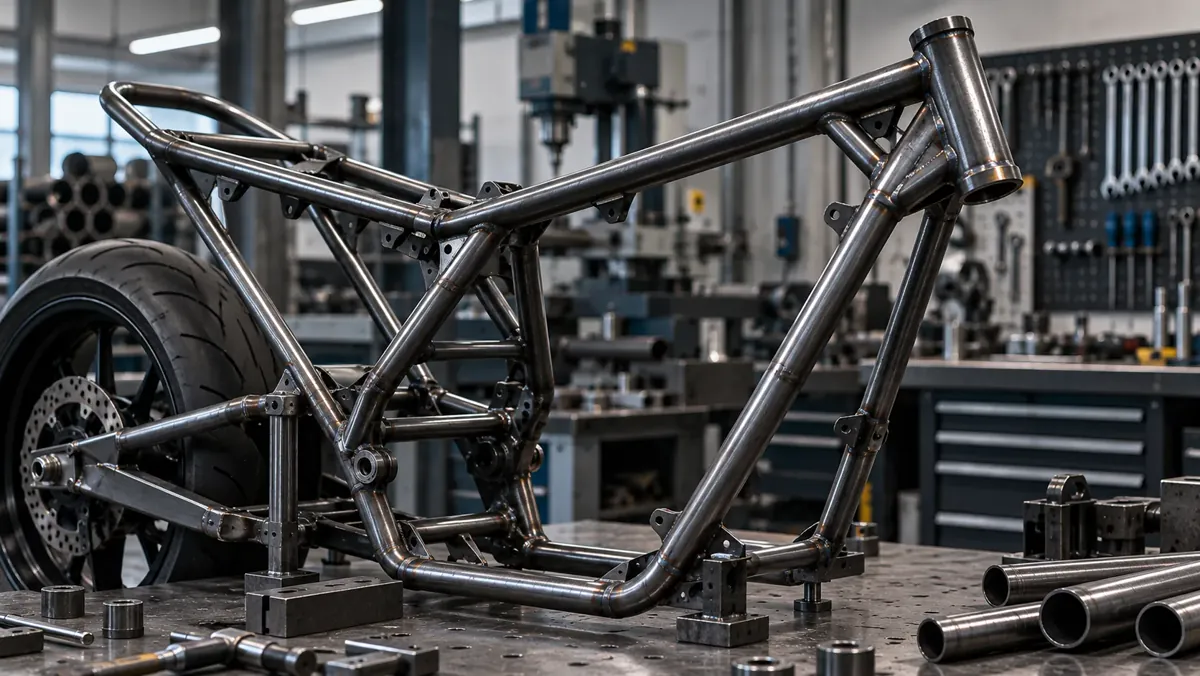
Motorcycle Frame Applications
A motorcycle tube frame carries the engine, transmission, suspension loads, and rider weight. The primary structural elements are:
- Backbone / spine: The main structural member connecting headstock to swingarm pivot
- Downtube: Front frame member from headstock, often carrying the engine
- Seat loop / rear subframe: Lighter structure supporting seat and tail
- Engine mounts: Gusseted tube structures that react engine torque and vibration
Custom Frame Material Considerations
For custom motorcycle frames intended for road use, the responsible builder must ensure the design and construction meet the applicable road vehicle regulations in the jurisdiction. Many countries require type approval or inspection of custom frames before road registration. Material certification (MTC) may be requested by inspection authorities as part of the homologation process.
| Application | Typical OD | Typical Wall |
|---|---|---|
| Backbone / main spine | 1.25"–1.75" | 0.065"–0.120" |
| Downtube | 1.00"–1.50" | 0.065"–0.095" |
| Seat loop / subframe | 0.875"–1.25" | 0.049"–0.083" |
| Engine mount gussets | 0.75"–1.00" | 0.065"–0.095" |
| Note | General guidance — frame engineer analysis required for road-legal builds |
Where the Loads Go
| Frame area | What it does | Tube approach |
|---|---|---|
| Steering head and gussets | Carries braking and steering loads from the fork | Heaviest section; well-gusseted joints |
| Backbone and down tubes | Connect the head to the swingarm pivot | Main structural tubes, largest diameters |
| Engine cradle | Supports the engine and its torque | Medium tubes with solid mounts |
| Swingarm pivot area | Transfers drive and suspension loads | Reinforced plates or heavy tube |
| Rear subframe | Carries rider and seat | Lighter tubes |
Braking forces try to bend the frame at the steering head, so that joint needs generous welds, gussets and a sound fit. Subframes can be much lighter. Round tube bends neatly into the curves a frame needs; plan bend radii around your tooling.
Frame geometry and tube sizes should come from a proven design or a qualified designer. Order normalized seamless tube and keep the certificate. Walls are compared in the wall thickness guide; welding is covered in the welding guide.
Frequently Asked Questions
Do I need an MTC for a custom motorcycle frame build?
MTC is good practice for any structural build. For road-legal custom motorcycle registration in many jurisdictions, an inspection authority may request material certification. Retain the MTC with your build documentation regardless of whether it is immediately required.
Which part of a motorcycle frame is most highly loaded?
The steering head area, which carries braking and steering loads from the fork.
Can a whole motorcycle frame be built from one tube size?
It can, but using heavier tube where loads are high and lighter tube elsewhere gives a better frame.
Which condition should frame tube be ordered in?
Normalized seamless tube.
Source 4130 for Motorcycle Frame Building
Provide your frame tube list with OD, wall, and footage requirements.
- OD & Wall per member
- Footage per size
- Cut requirements
- MTC required
- Delivery