
4130 Tubing Chemical Composition
The composition of 4130 is set by a specification, measured at the mill and reported on the certificate. Reading that report properly tells you more than whether the numbers fall inside the limits.
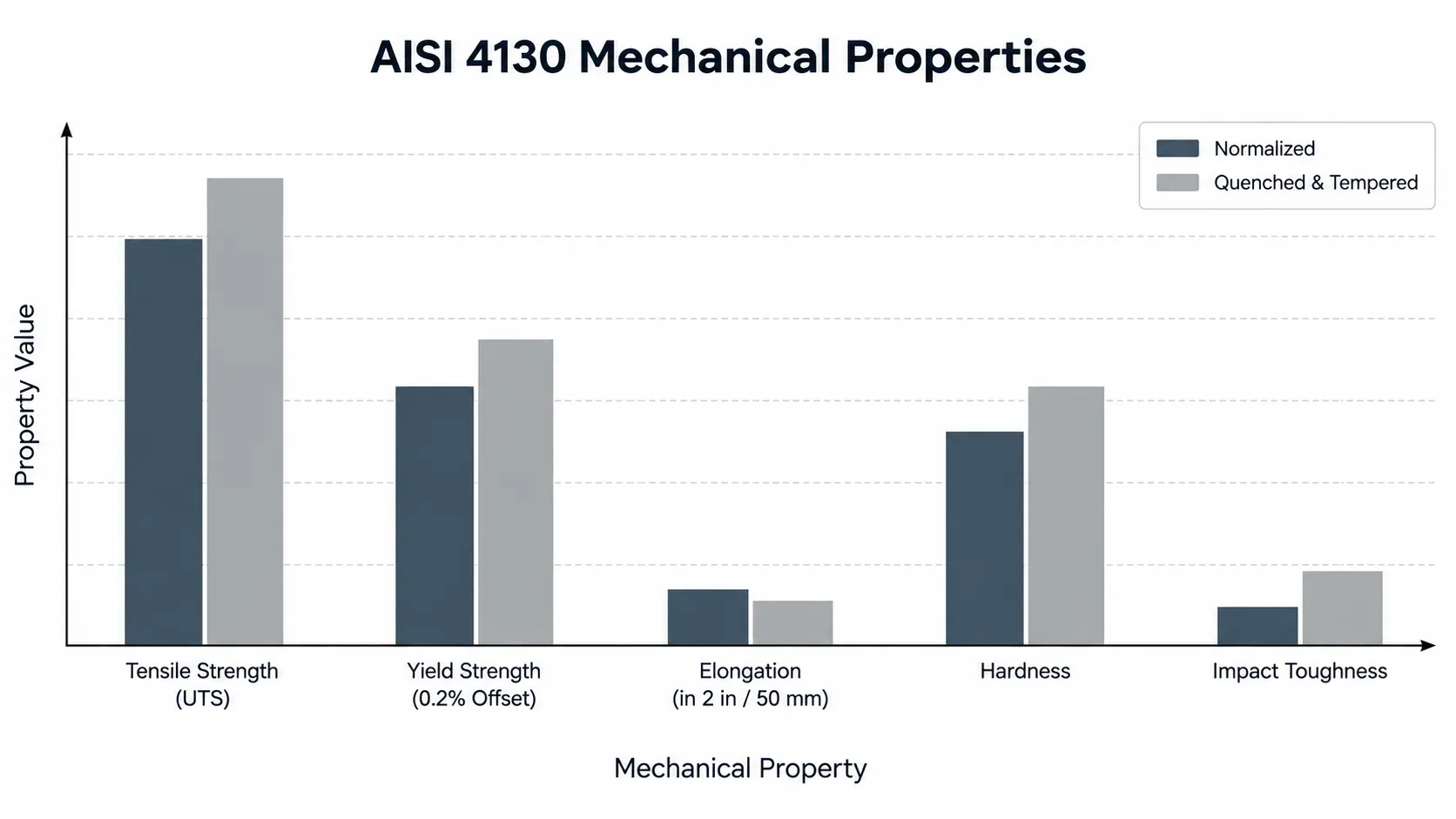
The Role of the Alloying Elements
- Carbon (C): At ~0.30%, it provides sufficient hardenability and strength without making the steel excessively brittle or unweldable.
- Chromium (Cr): Adds strength, hardness, and slightly improves resistance to scaling at moderate temperatures. (Note: at ~1%, it is not enough to make the steel 'stainless').
- Molybdenum (Mo): Increases high-temperature strength, hardenability, and improves the steel's toughness and fatigue resistance.
- Manganese (Mn): Acts as a deoxidizer during steelmaking and contributes to strength.
Standard Specification Limits
The table below shows the general composition limits for AISI/SAE 4130. The actual Ladle Analysis on your Mill Test Certificate (MTC) must fall within these ranges to be certified as 4130.
| Element | Symbol | Percentage Range (%) |
|---|---|---|
| Carbon | C | 0.28 – 0.33 |
| Chromium | Cr | 0.80 – 1.10 |
| Manganese | Mn | 0.40 – 0.60 |
| Molybdenum | Mo | 0.15 – 0.25 |
| Silicon | Si | 0.15 – 0.35 |
| Phosphorus (Max) | P | 0.035 max |
| Sulfur (Max) | S | 0.040 max |
| Iron | Fe | Balance |
Heat Analysis, Product Analysis and Carbon Equivalent
The figures on a mill test certificate are normally the heat analysis, also called ladle analysis, taken from the molten steel. A product analysis is a check on the finished tube; small differences from the heat analysis are permitted by the standards. Certificates may also list residual elements such as nickel and copper that were not added deliberately.
A useful number you can calculate yourself is the carbon equivalent, which estimates how readily a steel hardens beside a weld. A widely used formula is:
CE = C + Mn/6 + (Cr + Mo + V)/5 + (Ni + Cu)/15
For mid-range 4130 this gives roughly 0.30 + 0.08 + 0.23, about 0.6. Mild steel is typically below 0.4. The higher figure explains why 4130 needs more care in welding, especially in thick sections, as the welding guide describes. The effect of the two main alloying elements is discussed under chromium molybdenum 4130 tubing.
Frequently Asked Questions
Where do I find the exact composition of the tubing I purchase?
The exact composition of the specific batch of steel used to make your tubing is found under the 'Ladle Analysis' or 'Heat Analysis' section of the EN 10204 3.1 Mill Test Certificate provided with your delivery.
What is the difference between heat analysis and product analysis?
Heat analysis is taken from the molten steel. Product analysis is taken from the finished tube.
What is the carbon equivalent of 4130?
Around 0.6 for mid-range composition using the common formula, compared with under 0.4 for typical mild steel.
Why are nickel and copper listed on some certificates?
They are residual elements from the steelmaking charge, reported for information.
Quality Assured Material
All our 4130 tubing comes with full chemical analysis documentation (MTC 3.1). Request a quote today.
- OD & Wall
- Standard
- Footage
- Delivery