
4130 Tubing Wall Thickness Guide
Wall thickness is the second half of every tube specification. It sets the weight, the bore, the dent resistance and how the tube welds and bends, so it deserves as much thought as the diameter.
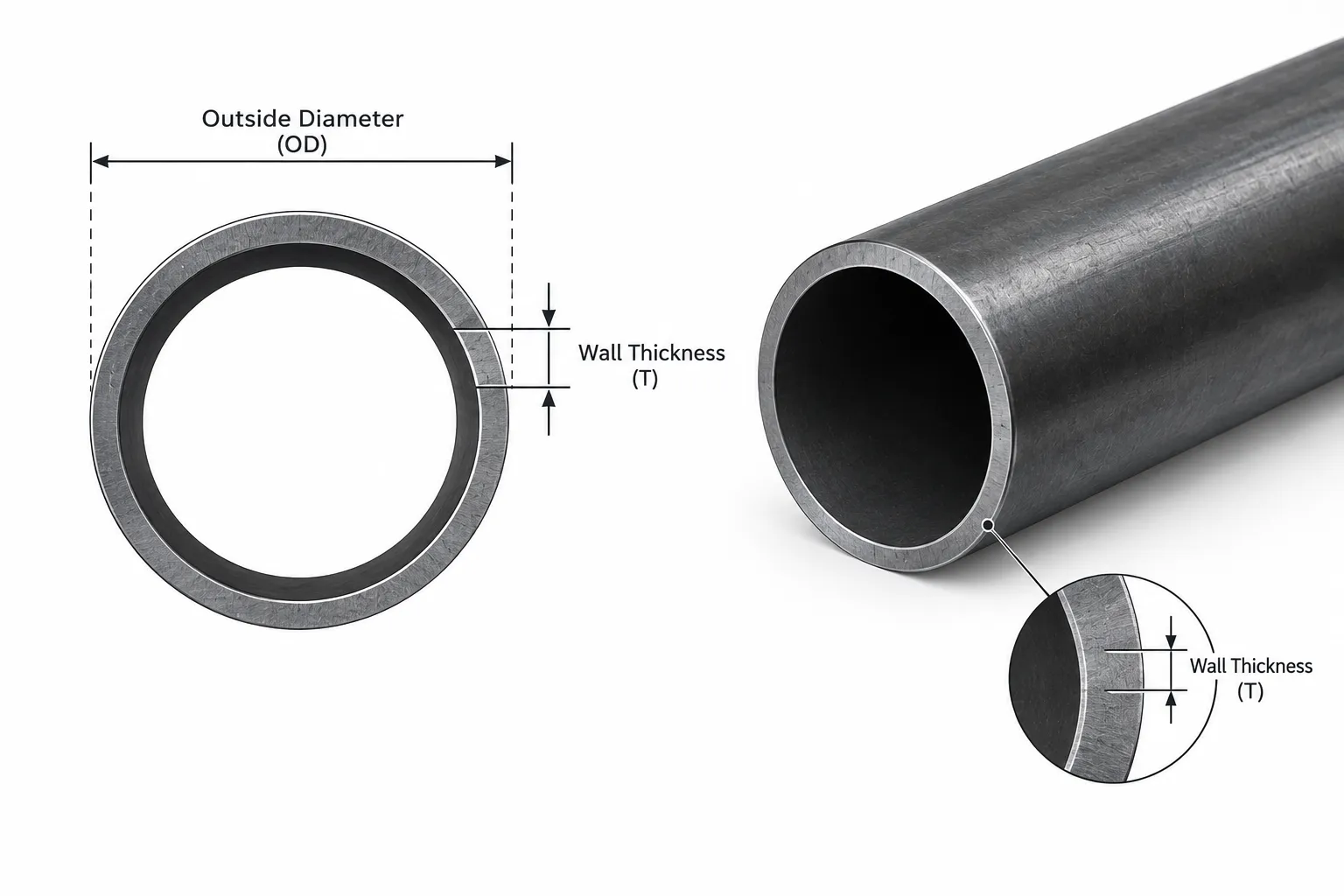
Factors Influencing Wall Selection
1. Regulatory Minimums: In motorsport and aerospace, sanctioning bodies define absolute minimum wall thicknesses for specific applications (e.g., 0.083" or 0.120" for roll cage main hoops based on vehicle weight).
2. Welding Considerations: Walls below 0.049" require high TIG welding proficiency to avoid burn-through. Walls above 0.120" generally require pre-heating to prevent heat-affected zone cracking.
3. Local Buckling: A very thin wall on a very large OD (a high OD/t ratio) is structurally inefficient as the tube wall may buckle or crumple under bending load before the material reaches its yield strength.
Common Wall Thickness Applications
While specific applications require engineering calculation, these are common usage patterns in fabrication:
| Wall Thickness | Typical Fabrication Application |
|---|---|
| 0.035" – 0.049" | Lightweight aircraft fuselages, bicycle frames, non-critical bracing |
| 0.065" | Secondary roll cage bars, suspension pushrods, light chassis rails |
| 0.083" | Primary roll cage members (lighter vehicles), main chassis structures |
| 0.095" – 0.120" | Primary roll cage main hoops (heavy vehicles), high-stress suspension mounts |
| 0.156" – 0.250"+ | Machining stock, heavy industrial columns, hydraulic cylinders |
Choosing Between Diameter and Wall
If a member needs to be stiffer, increasing the diameter is more efficient than thickening the wall. If it needs more resistance to denting, crushing at a joint, or thread and bung attachment, a heavier wall is the answer. Most good tube structures use a few diameters with the wall tuned to each member's job.
Think about fabrication too. Walls below about 0.058" need careful TIG technique; walls of 0.120" and above benefit from pre-heat. Tight bends favour heavier walls. Each common wall has its own page with a table of diameters, bores and weights: 0.035", 0.049", 0.065", 0.083", 0.095" and 0.120".
Frequently Asked Questions
Can I use the minimum wall thickness stated in a rulebook as the nominal order dimension?
Use caution. ASTM A519 allows for wall thickness manufacturing tolerances (typically +10%/-0% or similar depending on size). If a rulebook mandates an absolute minimum wall (e.g., 0.118" minimum measured by sonic tester), you should order a nominal wall that guarantees that minimum (e.g., 0.120" nominal) and verify the mill tolerance.
What is the most common wall thickness in 4130 tubing?
0.065", 0.083" and 0.095" are the most widely used structural walls. Lighter walls serve aircraft and bicycle work, heavier walls serve machinery.
How are gauge numbers related to wall thickness?
Tube walls follow the Birmingham Wire Gauge: 20 gauge is 0.035", 18 is 0.049", 16 is 0.065", 14 is 0.083", 13 is 0.095" and 11 is 0.120".
Does a thicker wall make a tube stiffer?
Slightly. Increasing the diameter raises stiffness far more than increasing the wall.
Order Specific Wall Thicknesses
We supply the full range of ASTM A519 verified wall thicknesses. Provide your requirements for a quote.
- OD & Wall
- Standard
- Footage
- MTC required
- Delivery