
4130 Seamless vs Welded Tubing
Seamless and welded tube can look alike and measure alike, yet they are made differently and are not treated the same by regulations. For 4130 the distinction is especially important.
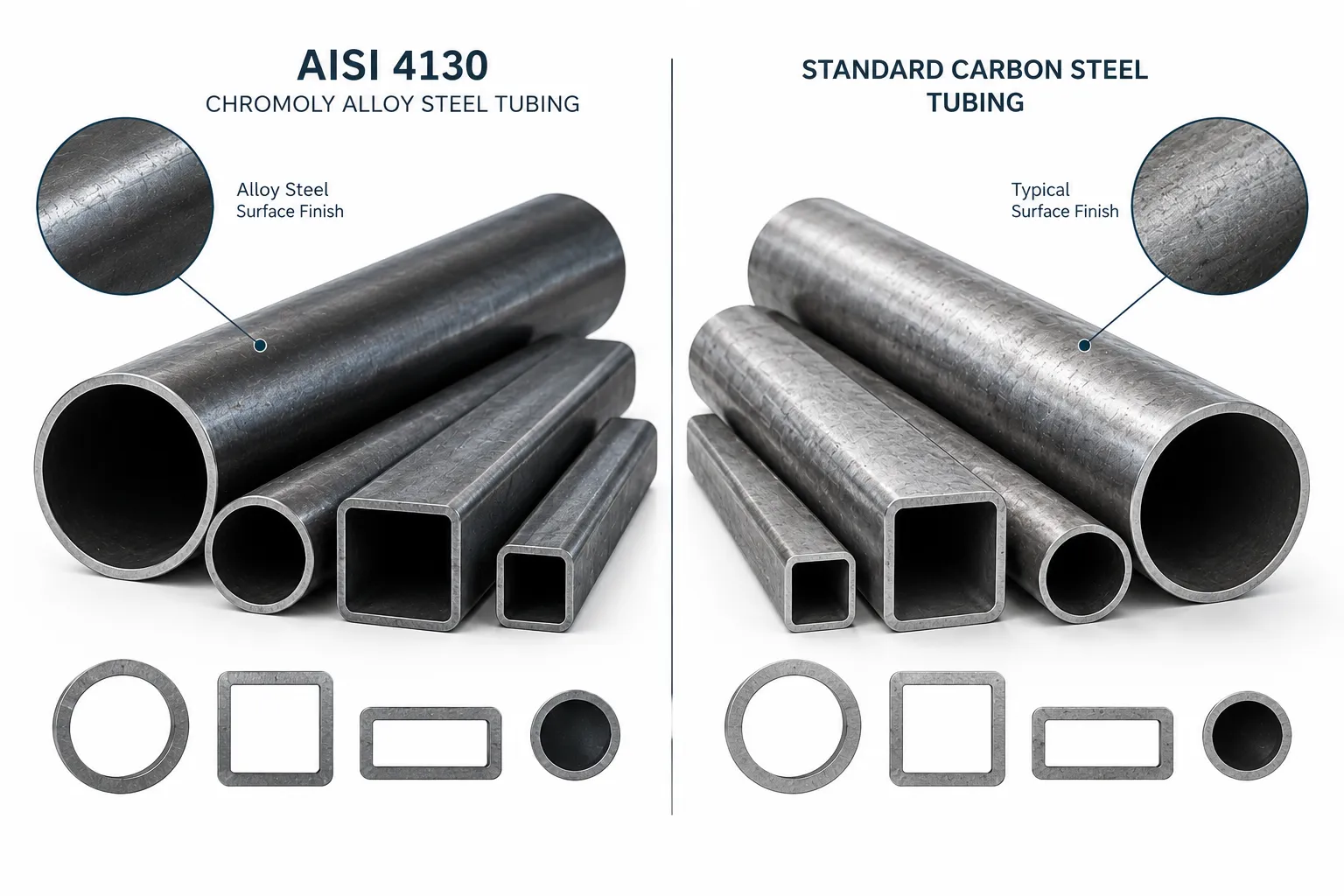
The Manufacturing Difference
Seamless 4130 tubing (CDS or HFS) is extruded and drawn from a solid billet. It has no longitudinal weld seam. The wall is structurally homogeneous around the entire circumference.
Welded tubing is formed by rolling flat strip into a cylinder and welding the longitudinal seam. Even if the weld is drawn over a mandrel (DOM) to smooth the finish, the heat-affected zone of the longitudinal weld remains a potential stress riser and point of metallurgical difference compared to the parent material.
Why Seamless is Mandated
Motorsport sanctioning bodies (FIA, SCCA, NHRA) and aerospace standards (AMS-T-6736) mandate seamless 4130 tubing for roll cages and primary structures for three reasons:
1. Torsional load continuity: A seamless tube reacts to torsional stress equally in all directions.
2. Bending performance: When bending tube for a roll cage hoop, a weld seam creates unpredictable yielding and a high risk of splitting. Seamless tube bends uniformly.
3. Fatigue resistance: In dynamic environments, the longitudinal weld seam is a prime candidate for fatigue crack initiation.
| Feature | 4130 Seamless (CDS) | Welded 4130 |
|---|---|---|
| Longitudinal Seam | None — homogeneous wall | Present (even if smoothed) |
| Motorsport Roll Cages | Mandated by most rules | Generally prohibited |
| Aerospace (AMS-T-6736) | Required | Not compliant |
| Bending Reliability | Excellent — uniform yielding | Poor — seam may split |
| Pressure Capacity | Calculable via standard formulas | Requires weld joint efficiency derating |
Side-by-Side Comparison
| Point | Seamless | Welded |
|---|---|---|
| How it is made | Pierced from a solid billet | Formed from strip and seam welded |
| Longitudinal seam | None | Present, though it may be hard to see after drawing |
| Wall uniformity | Some eccentricity possible | Very uniform, as it comes from rolled strip |
| Usual grades | Alloy steels such as 4130 | Mostly low carbon steels |
| Relative cost | Higher | Lower |
| Acceptance for alloy cages and aircraft | Normally required | Normally not accepted |
Welded tube is not inferior in every respect: its wall is often more uniform and it costs less. The issue for 4130 is that the alloy hardens readily, which makes a production seam weld metallurgically demanding, and that specifications for safety structures call for seamless material. If your rules or drawing say seamless, there is no substitute.
See 4130 seamless tubing for the product and 4130 vs DOM tubing for the most common welded alternative.
Frequently Asked Questions
Is 4130 DOM tubing the same as seamless?
No. DOM (Drawn Over Mandrel) refers to a cold-working process applied to welded tubing to improve dimensional accuracy and smooth the weld seam. While the seam may be invisible to the naked eye, DOM is still fundamentally a welded tube. It is not seamless and does not meet rules requiring seamless material.
Is welded tube weaker than seamless?
Not necessarily in a static test, but a seam is a potential weak line and many specifications require seamless for critical use.
Why does seamless tube cost more?
Piercing and drawing a billet takes more processing than forming and welding strip.
Source Genuine 4130 Seamless Tubing
All our structural 4130 supply is 100% seamless (CDS or HFS). Specify OD, wall, and condition for a quotation.
- OD & Wall
- Standard (ASTM A519 / AMS)
- Condition
- Footage
- MTC required
- Delivery