
4130 Tubing for Structural Fabrication
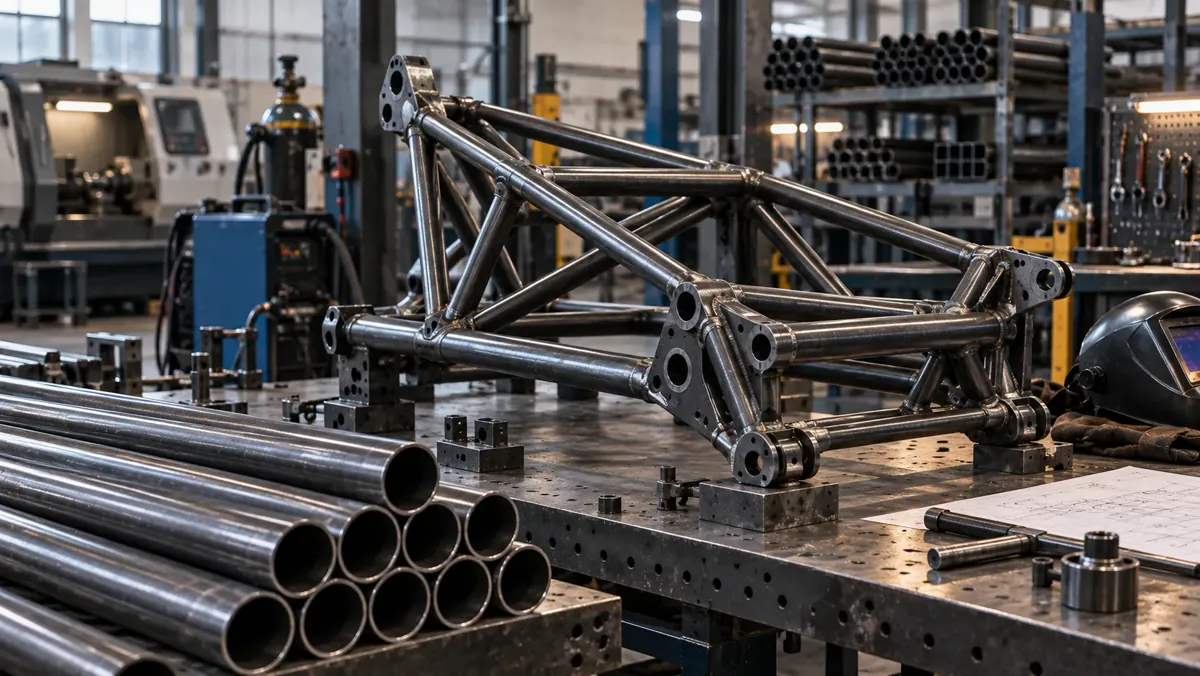
4130 tubing is a structural material in the engineering sense, used for equipment frames, vehicle structures and machines. It is not a conventional construction steel, and that difference shapes how it should be used.
When to Choose 4130 Over Mild Steel
The decision framework for structural tube material:
- If the structure can accommodate a larger OD or heavier wall in mild steel without weight penalty: use mild steel (lower cost, easier welding).
- If weight, compactness, or strength requirements make mild steel inadequate at practical cross-sections: specify 4130 CDS.
- If the structure must be welded by semi-skilled operators: mild steel is more forgiving of welding imperfections.
- If the structure has fatigue loading and requires high yield strength: 4130 provides better fatigue performance at equivalent section size.
Fabrication Notes for 4130
Structural fabrication in 4130 requires attention to:
- Weld process: TIG (GTAW) for quality joints; MIG with appropriate wire as a secondary option.
- Pre-heat: Not required for thin-wall 4130 in ambient conditions; recommended for wall thicknesses above approximately 0.120" or in cold environments.
- Filler metal: ER70S-2 or ER80S-D2 — match to joint requirements.
- Post-weld treatment: Not required for most structural applications; post-weld normalising recommended for highly stressed or impact-loaded structures.
| Design Criterion | 4130 Advantage Over Mild Steel |
|---|---|
| Yield strength | Higher — allows thinner wall for same load |
| Fatigue resistance | Better at equivalent strength level |
| Weight saving | Yes — at same structural performance |
| Weld difficulty | Higher — requires TIG skill |
| Material cost | Higher — premium over mild steel |
| MTC requirement | Required — ensure grade traceability |
Design Codes and Joint Design
Building and bridge codes work from lists of approved structural steels with defined properties and welding rules. 4130 is generally not on those lists, so it is unusual in building structures. Its natural home is in equipment and vehicles designed from first principles or to industry-specific rules, where a high strength-to-weight ratio earns its cost.
If you are designing such a structure:
- Base the design on properties confirmed by testing, not on typical values.
- Allow for the zone beside each weld, which may be softer or harder than the parent tube.
- Keep joints away from the most highly stressed regions where you can.
- Use gussets and generous fillets to spread load at joints.
- Avoid sudden changes of section that concentrate stress.
- Specify the welding procedure, including pre-heat for heavier walls.
For structures where low cost and code compliance outweigh weight, a standard structural steel is usually the better choice, as discussed on 4130 vs mild steel. Welding practice is in the welding guide.
Frequently Asked Questions
Can 4130 tube be MIG welded for structural fabrication?
MIG welding of 4130 is possible using appropriate wire (ER80S-D2 or similar) and technique. For structural joints, TIG is preferred for quality control. MIG may be acceptable for secondary members and non-critical joints with appropriate procedure qualification.
Is 4130 used in building structures?
Rarely. It is not among the steels normally listed in building codes. It is used in equipment, vehicles and machinery.
What should a 4130 structural design be based on?
Tested material properties and a defined welding procedure.
Source 4130 for Structural Fabrication
Provide your structural tube specification — OD, wall, standard, footage, and MTC requirement.
- OD & Wall
- Standard (ASTM A519)
- Condition
- Footage
- MTC
- Delivery