
4130 vs Mild Steel Tubing
4130 is stronger than mild steel, and that is the whole of its advantage. Understanding what strength does and does not buy you is the key to choosing between them.
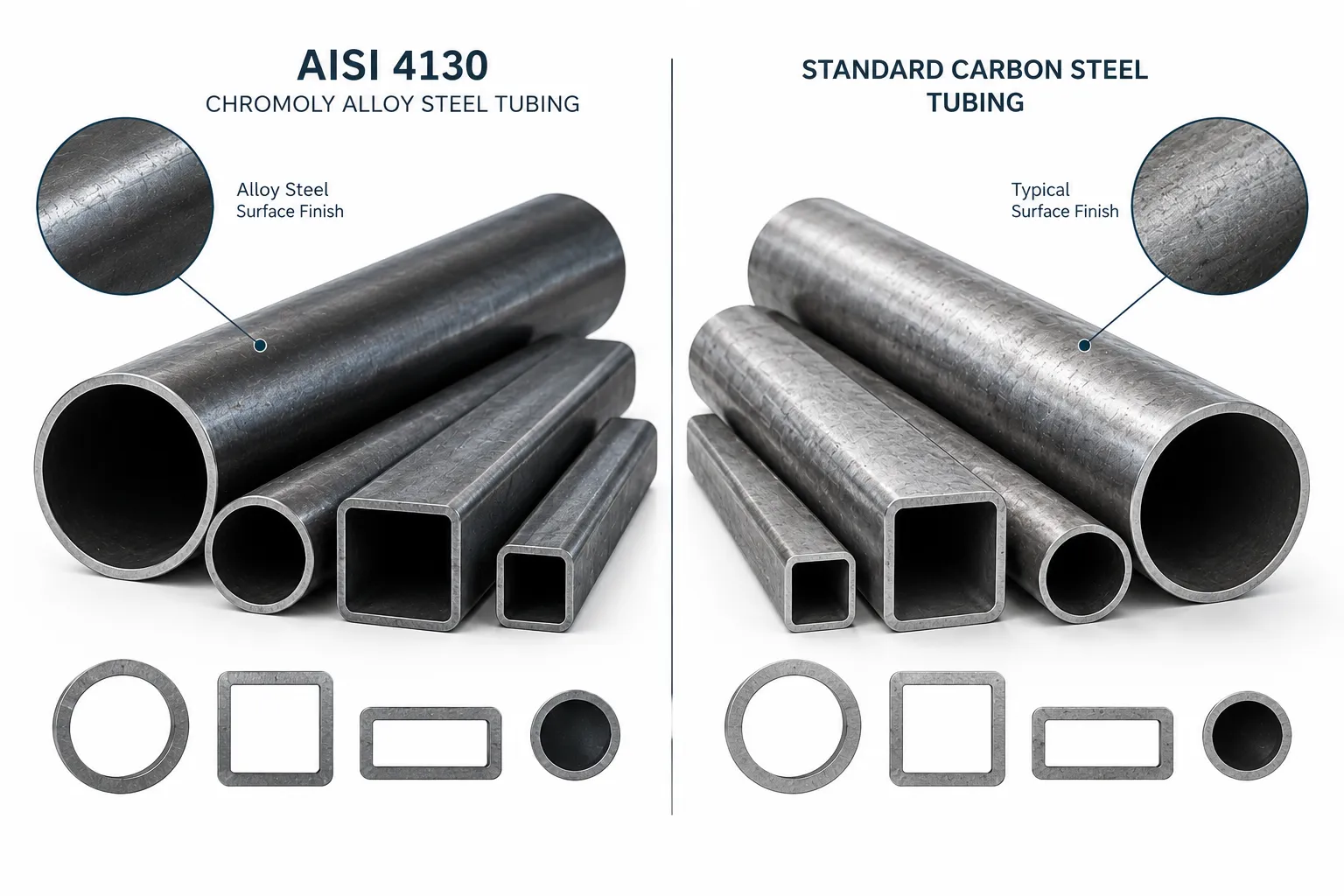
The Strength-to-Weight Advantage
4130 chromoly and mild steel have the same density (they weigh exactly the same per cubic inch). 4130 does not save weight by being a 'lighter metal'.
4130 saves weight because its significantly higher yield strength allows the engineer to use a thinner wall to achieve the same structural load capacity. For example, replacing a 0.120" wall mild steel tube with a 0.083" wall 4130 tube provides similar or greater strength while cutting the tube weight by roughly 30%.
Fabrication and Welding
Mild steel is highly forgiving. It can be MIG welded quickly by operators with moderate skill, and does not require pre-heat or post-weld heat treatment in typical tube thicknesses.
4130 requires more control. TIG (GTAW) welding is strongly recommended for structural joints to control heat input and prevent hydrogen embrittlement. Filler rod selection (e.g., ER70S-2) is critical. For thicker walls (generally above 0.120"), 4130 requires pre-heating to prevent weld cracking.
| Consideration | 4130 Chromoly | Mild Steel (1020/DOM) |
|---|---|---|
| Density (Weight) | Identical (~7.85 g/cm³) | Identical (~7.85 g/cm³) |
| Yield Strength | Significantly Higher | Lower |
| Weight Saving Method | Allows thinner wall | N/A — requires thicker wall |
| Preferred Welding | TIG (GTAW) | MIG (GMAW) or TIG |
| Material Cost | Higher (Premium alloy) | Lower (Commodity steel) |
| Form | Typically Seamless (CDS) | Typically Welded / DOM |
Strength Is Not Stiffness
Both steels have the same elastic modulus, so two tubes of identical size deflect by the same amount under the same load, whatever they are made of. What differs is the load at which the tube starts to bend permanently. 4130 reaches a much higher stress before yielding.
That lets you use a thinner wall. Compare two tubes of 1.500" OD:
| Tube | Weight | Relative weight |
|---|---|---|
| Mild steel, 0.120" wall | 1.77 lb/ft | 100 % |
| 4130, 0.083" wall | 1.26 lb/ft | about 71 % |
Where a rulebook permits the thinner 4130 tube, the structure is nearly 30 percent lighter. The thinner tube is, however, less stiff than the thicker one, so a 4130 structure designed purely for weight can flex more.
Choose mild steel when cost and ease of welding matter most and weight does not. Choose 4130 when weight matters and you can control welding quality. See also 4130 vs DOM tubing and the weight chart.
Frequently Asked Questions
Can I weld 4130 to mild steel?
Yes, 4130 can be welded to mild steel. The joint strength will be limited by the weaker material (the mild steel). Standard mild steel filler metals like ER70S-2 are commonly used for these dissimilar joints.
Is 4130 tubing stiffer than mild steel tubing?
No. At the same dimensions they are equally stiff. 4130 is stronger, allowing a lighter section.
How much weight can 4130 save?
Often 20 to 30 percent, where rules or design allow a thinner wall than mild steel would need.
Source 4130 Structural Tubing
Upgrade your structural fabrication with high-yield 4130 seamless tubing. Provide OD and wall requirements.
- OD & Wall
- Standard (ASTM A519)
- Footage
- MTC required
- Delivery