
4130 Tubing for Industrial Machinery
Machine builders use 4130 tubing where a hollow part has to be strong: a roller that must not bend, a sleeve that carries a bearing, a spindle that transmits torque.
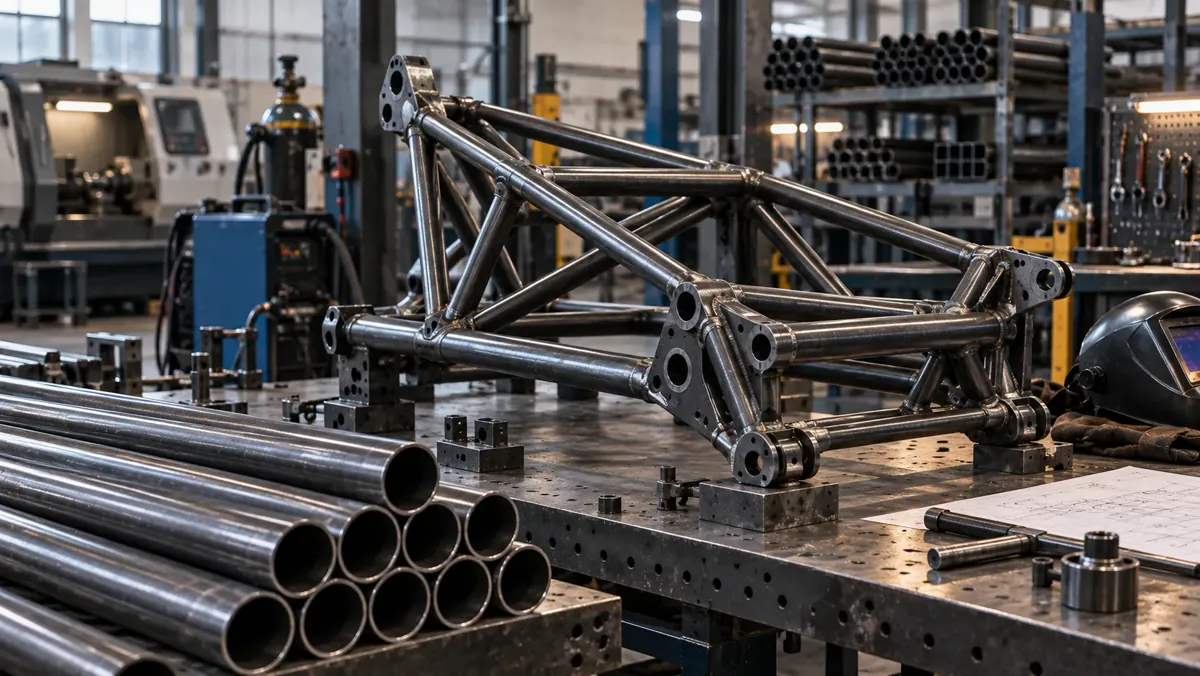
Why 4130 in Industrial Machinery
Machine components subject to repeated loading — vibration, impact, cyclic stress — benefit from 4130's toughness and fatigue resistance compared to plain carbon steel at equivalent strength levels. The alloy responds well to quench-and-temper heat treatment, allowing a designer to specify a required minimum yield strength and achieve it in section sizes where plain carbon steel hardenability would be insufficient.
For tube-based machining applications, 4130 CDS is preferred because the tight dimensional tolerances reduce machining allowances and the bright surface finish simplifies pre-machining inspection.
OEM Procurement Considerations
Industrial OEM buyers typically require consistent material quality across production runs. Key considerations for 4130 OEM supply:
- Heat-to-heat consistency: Request that large orders are supplied from a single heat lot where possible to minimise material variability
- MTC retention: Retain MTC for each heat lot for quality system traceability
- Condition consistency: Specify the required condition explicitly — different conditions produce different mechanical properties
| OEM Parameter | Procurement Consideration |
|---|---|
| Grade | AISI 4130 — confirm on MTC for each delivery |
| Form | Cold Drawn Seamless for machined components |
| Condition | State required condition explicitly (As-drawn, Normalized, Q&T) |
| Heat lot | Request single heat lot for large orders — reduces variability |
| MTC | EN 10204 3.1 — retain for QMS traceability |
| OD & Wall | State required dimension and tolerance class |
| Volume | State expected annual or project volume for pricing and lead time |
Machine Parts Made From 4130 Tube
| Part | Why tube is used | Usual condition |
|---|---|---|
| Rollers and idlers | Light, stiff and ready-bored | Normalized or stress relieved |
| Sleeves, bushes and spacers | Little machining from a close starting size | Annealed for machining |
| Hollow shafts and spindles | High torsional strength for the weight | Heat treated after machining |
| Guide columns and tie bars | Strength in a slender section | Normalized or heat treated |
| Couplings and collars | Machined from heavy-wall tube | Annealed, then heat treated |
For machined parts, order by the finished dimensions and let the starting size be selected to clean up. Ask for the condition that suits your process: annealed if you will machine and then harden, normalized or stress relieved if the part is used without further heat treatment.
Straightness matters for anything that rotates. State the limit you need, and for rollers and shafts consider stress relieved tube, which moves less when machined. See 4130 mechanical tubing and stress relieved tubing.
Frequently Asked Questions
Is 4130 a suitable replacement for 4140 in industrial machinery?
4130 and 4140 are closely related Cr-Mo alloys. 4140 has higher carbon content (nominally 0.40%) which allows higher hardness after quench-and-temper. If the application requires peak hardness or wear resistance, 4140 may be preferred. If weldability is important, 4130 is easier to weld. A materials engineer should assess the specific application requirements.
Which condition is best for machining 4130 tube?
Annealed gives the best machinability. Stress relieved tube holds its shape better during machining.
Why use tube instead of bar for machine parts?
A hollow starting size removes less metal and saves machining time.
Source 4130 for Industrial Machinery Production
Provide grade, condition, OD/wall, tolerance class, annual volume, and MTC requirements for an OEM supply quotation.
- Grade: AISI 4130
- Condition
- OD & Wall + tolerance class
- Annual volume estimate
- MTC requirement
- Single heat lot preference
- Delivery schedule