
4130 vs 4140 Tubing
4130 and 4140 belong to the same chromium-molybdenum family and differ in one important respect: carbon. That single difference sends them into different kinds of work.
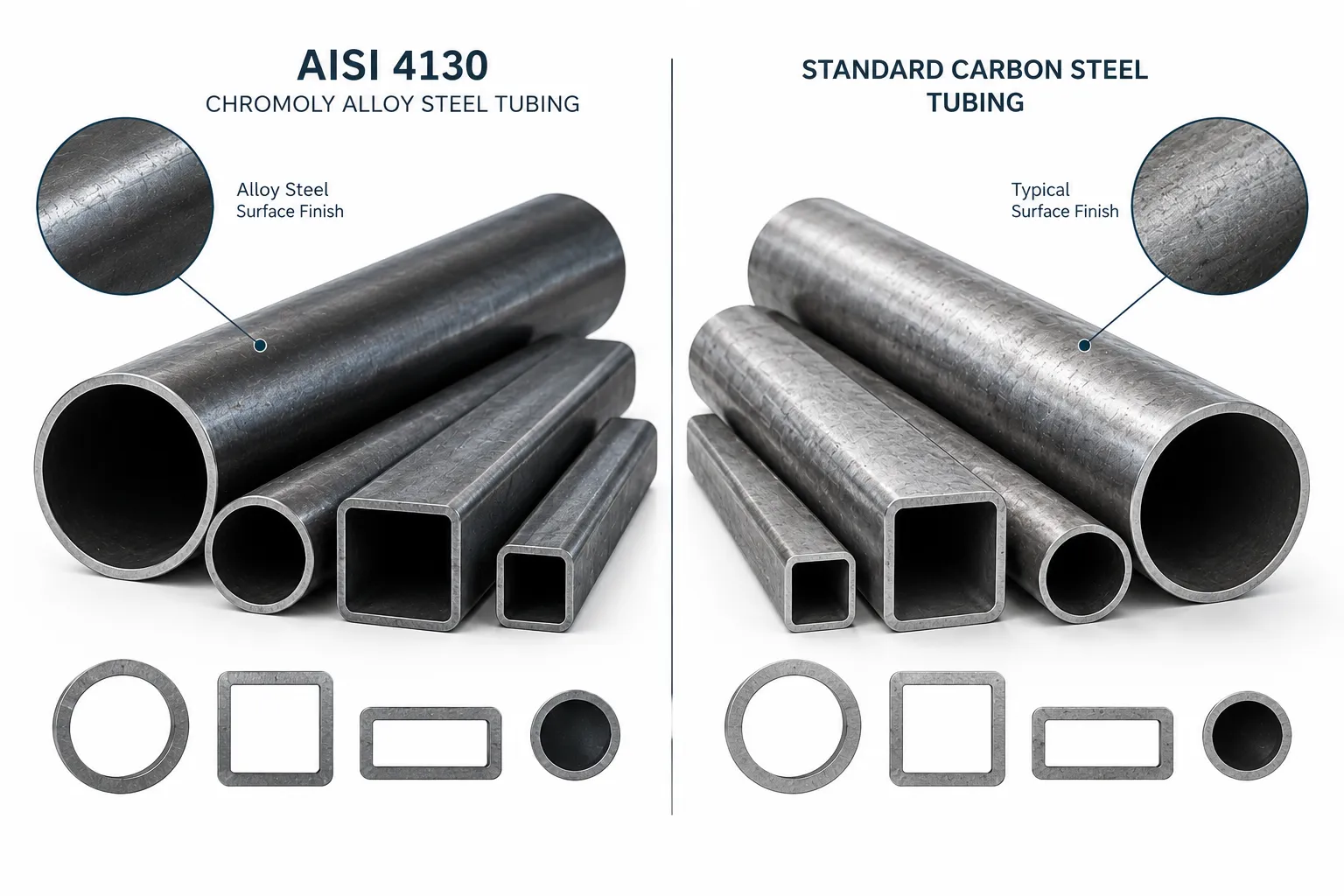
The Carbon Difference
The last two digits of the AISI designation indicate the nominal carbon content in hundredths of a percent:
- 4130 has nominally 0.30% carbon (allowable range ~0.28–0.33%).
- 4140 has nominally 0.40% carbon (allowable range ~0.38–0.43%).
While this 0.10% difference seems small, it radically changes how the steel responds to heat treatment and welding.
Weldability vs Hardenability
4130 (Lower Carbon): Retains good weldability. It is the preferred choice for welded tubular structures (roll cages, airframes, chassis) because it is less prone to heat-affected zone (HAZ) cracking. It achieves excellent strength but does not reach the peak hardness of 4140.
4140 (Higher Carbon): Has higher hardenability, meaning it can achieve higher ultimate tensile strength and surface hardness through quench and temper. However, this higher carbon content makes 4140 significantly more difficult to weld. It requires strict pre-heat, interpass temperature control, and post-weld heat treatment to prevent cracking. 4140 is rarely used for welded tube structures; it is used for machined shafts, gears, and heavy tooling.
| Attribute | 4130 Chromoly | 4140 Chromoly |
|---|---|---|
| Nominal Carbon | 0.30% | 0.40% |
| Primary Advantage | Weldable structural strength | High hardenability / peak strength |
| Typical Product Form | Seamless Tubing, Sheet | Solid Bar, Heavy Forgings |
| Weldability | Good (TIG preferred) | Poor (Requires strict pre/post-weld heat control) |
| Typical Application | Roll cages, airframes | Shafts, gears, drill collars |
Composition and Typical Use
| Point | 4130 | 4140 |
|---|---|---|
| Carbon | 0.28 – 0.33 % | 0.38 – 0.43 % |
| Manganese | 0.40 – 0.60 % | 0.75 – 1.00 % |
| Chromium | 0.80 – 1.10 % | 0.80 – 1.10 % |
| Molybdenum | 0.15 – 0.25 % | 0.15 – 0.25 % |
| Weldability | Good with correct procedure | Difficult; needs pre-heat and post-weld treatment |
| Most common form | Seamless tube | Bar and forgings |
| Typical use | Welded frames, cages, aircraft structures | Shafts, gears, bolts, machined parts |
More carbon means 4140 can be heat treated to a higher hardness and strength, which suits parts that are machined and then hardened. The same carbon makes it prone to cracking when welded, which rules it out for fabricated tube structures.
If a part will be welded, choose 4130. If it is a machined component that needs maximum hardness and will not be welded, 4140 bar or heavy-wall tube may be the better fit. European equivalents are compared under Werkstoff 1.7218 tubing.
Frequently Asked Questions
Can I use 4140 tubing for a roll cage instead of 4130 to make it stronger?
No. Using 4140 for a welded roll cage is dangerous. The welding process would create brittle, crack-prone joints due to the higher carbon content. 4130 is the correct specification for welded tubular structures.
Is 4140 stronger than 4130?
After heat treatment it can reach higher strength and hardness, because of its higher carbon content.
Why is 4130 used for tubing instead of 4140?
Its lower carbon makes it far easier to weld, which is essential for fabricated tube structures.
Source 4130 Structural Tubing
For welded structural applications, 4130 is the correct alloy choice. Provide your tube requirements for a quotation.
- OD & Wall
- Standard (ASTM A519)
- Footage
- MTC required
- Delivery