
4130 Tubing for Hydraulic Systems
In a hydraulic system, 4130 is a component material more than a plumbing material. It is used where a part must contain pressure in a compact, high-strength section.
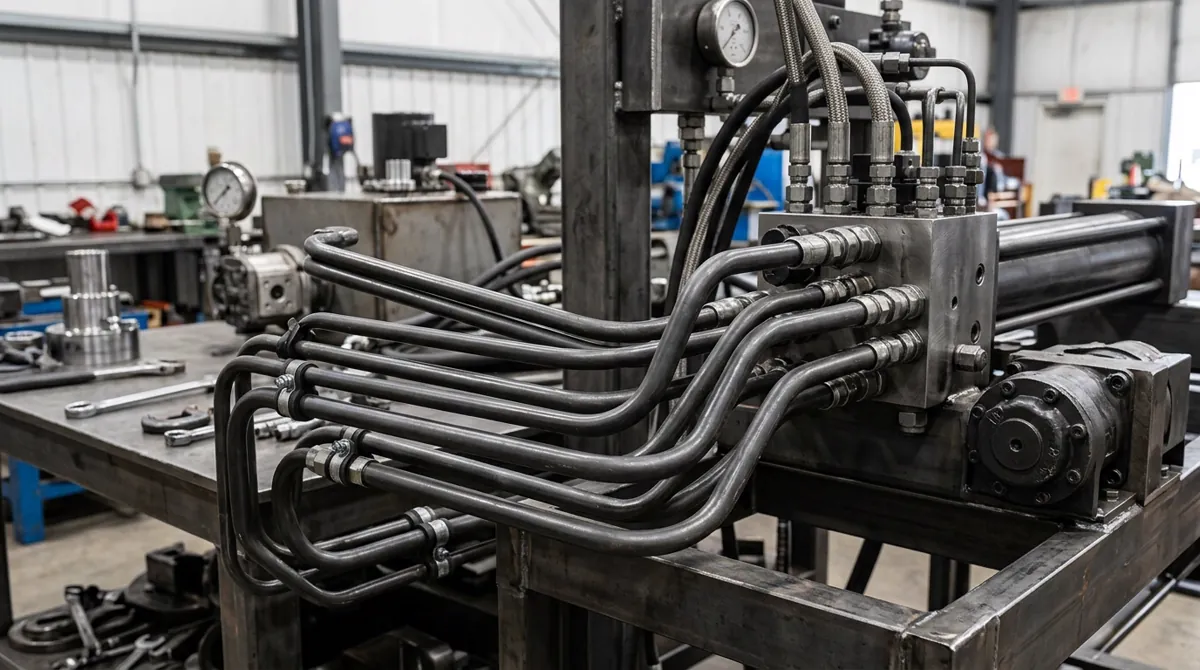
Why 4130 for Hydraulic Lines
In a hydraulic system, the tube wall carries internal pressure as hoop stress. Higher material yield strength allows thinner walls at the same design pressure — reducing the tube weight and the volume of hydraulic fluid in the system (which affects response time). 4130 seamless provides this strength advantage over mild steel DOM or ERW tube. The seamless construction also eliminates the longitudinal seam as a potential fatigue-initiation site under cyclic pressure loading.
System Design Considerations
Designing 4130 hydraulic tubing into a system requires the engineer to address:
- Wall thickness: Calculated from the design pressure, OD, safety factor, and material allowable stress per the applicable code (e.g., ASME B31.3, SAE J1677)
- Bending: Tube must be bent to route around obstacles; minimum bend radius must be respected to avoid wall thinning or cracking
- Fitting compatibility: OD tolerance of the tube must match the fitting specification (Parker, Swagelok, JIC, or other)
- Vibration: Clamping and routing must prevent resonance at system operating frequencies
| Engineering Parameter | Hydraulic System Consideration |
|---|---|
| Tube form | Cold Drawn Seamless — mandatory; no weld seam for cyclic pressure |
| Wall thickness | Calculated per applicable pressure code and safety factor |
| Fitting compatibility | Confirm OD tolerance vs fitting specification |
| Bending | Minimum bend radius per OD and wall — confirm with tube bending guidelines |
| Vibration clamping | Clamp spacing determined by tube size and system vibration level |
| MTC | EN 10204 3.1 — retain for system documentation |
Hydraulic Components Made From 4130
| Component | How 4130 tube is used |
|---|---|
| Cylinder barrels | Heavy-wall tube bored and honed to a smooth, accurate bore |
| Cylinder end caps and glands | Machined from tube or bar |
| Piston and guide sleeves | Turned from tube |
| High-pressure tool bodies | Machined, then heat treated to strength |
| Accumulator and intensifier shells | Machined from heavy-wall seamless tube |
A cylinder bore has to be round, straight and smooth for the seals to work. Tube intended for barrels is therefore ordered with enough stock for boring and honing, or as tube already finished on the bore. State the finished bore, the working pressure and the surface finish required.
The strength used in the design must be supported by test results, so order with mechanical testing, and consider ultrasonic inspection for high-pressure parts. Piston rods are normally made from plated bar, not tube. See 4130 hydraulic tubing and heavy wall tubing.
Frequently Asked Questions
Is 4130 tubing rated for a specific hydraulic pressure?
No. Pressure capacity is not a fixed property of a tube — it depends on the wall thickness, OD, material condition, applicable safety factor, and design code. The hydraulic system engineer must calculate allowable working pressure for each tube size in the circuit.
Is 4130 used for hydraulic cylinder barrels?
Yes, particularly where high strength allows a thinner wall or higher pressure. The bore is machined and honed.
What should I state when ordering cylinder tube?
The finished bore and OD, working pressure, surface finish, condition and any testing required.
Source 4130 for Hydraulic System Build
Provide your hydraulic line specifications including OD, wall, system pressure (for engineering reference), fitting type, and bend requirements.
- OD & Wall
- System pressure (reference)
- Applicable standard or code
- Fitting type / OD tolerance required
- Bending requirement
- Quantity
- MTC
- Delivery