
4130 Hydraulic Tubing
"Hydraulic tubing" covers two different products: the small lines that carry fluid between components, and the larger tube from which cylinders are made. 4130 has a role in the second more than the first.
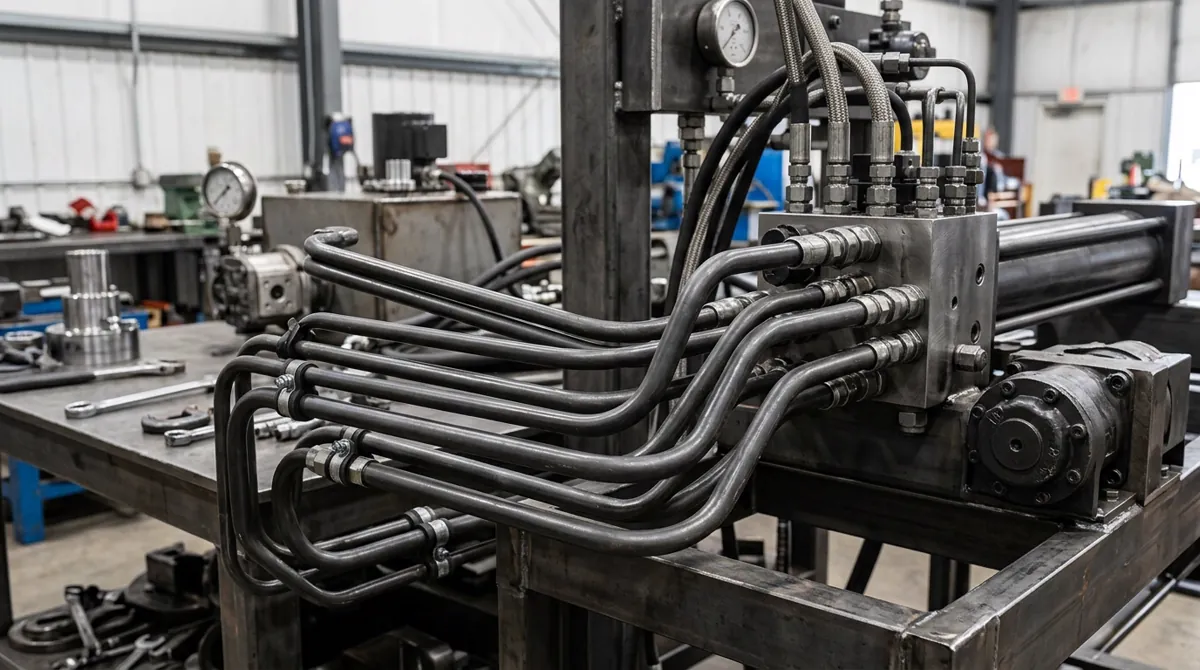
Why Seamless Matters for Hydraulic Service
In hydraulic tubing, internal pressure loads are transmitted through the tube wall as hoop stress. The stress concentration created by a longitudinal weld seam — even in high-quality DOM tubing — represents a potential initiation site for fatigue cracking under cyclic pressure loading. Seamless 4130 CDS tubing eliminates this seam, providing uniform hoop stress distribution around the entire circumference.
Important Note on Pressure Ratings
ASTM A519 mechanical tubing is not specifically pressure-rated under a vessel code. If a hydraulic line must comply with a pressure vessel code (such as ASME B31.3 for pressure piping), the design engineer must calculate the allowable working pressure based on the tube dimensions, material properties, applicable code, and design temperature. Do not assume that any stated wall thickness automatically provides a specific working pressure without an engineering calculation.
| Parameter | 4130 Hydraulic Tubing — Buyer Considerations |
|---|---|
| Form required | Cold Drawn Seamless (CDS) — no weld seam |
| Standard | ASTM A519 — confirm if pressure code compliance is required |
| Pressure rating | Not inherent — engineering calculation required per applicable code |
| Wall selection | Determined by design pressure, OD, and safety factor — consult engineer |
| Bending | Specify if tube must be bent — minimum bend radius depends on OD and wall |
| Fitting compatibility | Confirm OD tolerance vs fitting specification |
| MTC required | Yes — state requirement at enquiry stage |
Line Tube and Cylinder Tube
Hydraulic line tube is normally a soft, annealed low carbon steel or stainless tube made to a hydraulic line standard. It is soft on purpose: it has to be bent on site, flared, and gripped by compression fittings. Normalized 4130 is considerably harder, so it does not flare easily and may exceed the tube hardness that fitting manufacturers allow. If 4130 is proposed for lines, check the fitting maker's hardness limit and order annealed tube.
Cylinder barrels, rods and pressure-containing bodies are a better match. There the strength of 4130 allows a thinner wall or a higher working pressure, and the part is machined and often heat treated. The design must follow the applicable pressure code, since ASTM A519 tube is not pressure rated as supplied. See 4130 pressure tubing and 4130 tubing for hydraulic systems.
Frequently Asked Questions
Is 4130 tubing suitable for aircraft hydraulic lines?
4130 CDS tubing is used for aircraft hydraulic lines, but the application must be engineered to the applicable aircraft standards (e.g., MIL-H-5440, relevant FAA/EASA requirements). The specific OD, wall, fitting, and installation requirements are determined by the aircraft type design or MRO authority.
Can I use schedule-based sizing for 4130 hydraulic tubing?
4130 mechanical tubing is sized by OD and wall thickness — not by pipe schedule. Schedule designations (Schedule 40, 80, etc.) apply to pipe (NPS nominal bore system), not mechanical tubing. Specify OD and wall for all 4130 mechanical tube requirements.
Can 4130 tube be flared for hydraulic fittings?
Only in the annealed condition and with care. Normalized 4130 is generally too hard for reliable flaring.
Is 4130 used for hydraulic cylinders?
Yes, for high-strength cylinder components that are machined and designed to the relevant pressure code.
Source 4130 Hydraulic Tubing
Specify your OD, wall, system pressure requirement, applicable code, and fitting compatibility for a hydraulic tubing quotation.
- OD & Wall
- System pressure (for engineering reference)
- Applicable standard or code
- Bending requirement (if applicable)
- Fitting specification
- Quantity
- MTC
- Delivery