
4130 Tubing for Racing
Every form of racing uses 4130 tubing, but not in the same way. The loads, the rules and the typical tube sizes change from one discipline to the next.
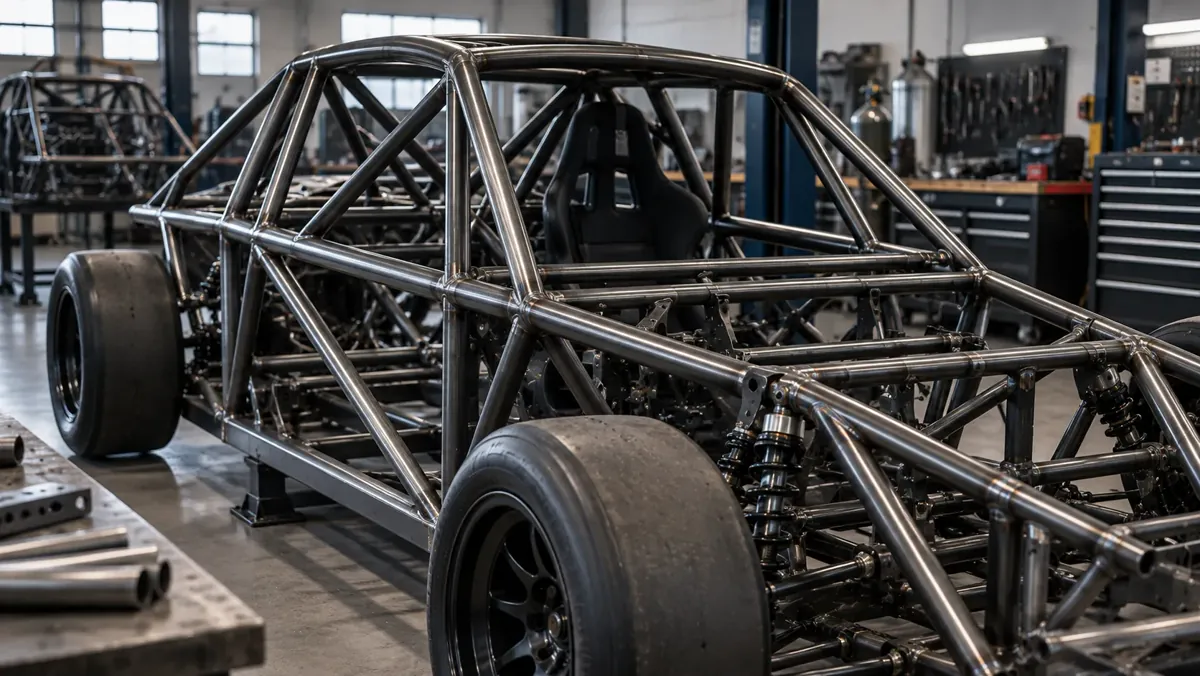
Racing Applications by Structure
Different racing vehicle structures use 4130 in different configurations:
- Roll cage and safety structures: Governed by sanctioning body rules; specific minimum sizes required.
- Spaceframe chassis: Engineer-analysed tube sizes for primary frame members, with lighter secondary bracing.
- Suspension pickup tubes: Short tube sections that form the outer housing of bearing or rose joint assemblies; often machined from solid bar rather than tube.
- Push/pull rods (open-wheel): Axially loaded members where the thin-wall tube carries compression/tension; size determined by column buckling analysis.
- Fuel cell / tank frames: Structural cage protecting the fuel cell; sized for crash protection.
Mixed Sizes — Ordering Strategy
A complete racing build typically requires multiple tube sizes. Ordering strategy:
1. Compile a complete cut list from your design or plans
2. Sum footage per OD/wall combination
3. Add 10–15% waste allowance for cuts, miters, and mistakes
4. Order all sizes together to simplify MTC documentation and logistics
| Racing Application | Typical OD Range | Typical Wall Range |
|---|---|---|
| Main hoop / primary cage | 1.50"–1.75" | 0.083"–0.120" |
| Secondary cage bars | 1.00"–1.50" | 0.065"–0.095" |
| Chassis rails (formula car) | 1.00"–1.50" | 0.049"–0.083" |
| Suspension rods (axial load) | 0.50"–0.875" | 0.049"–0.065" |
| Note | General guidance — structural analysis required for any safety-critical member |
Chromoly Across the Disciplines
| Discipline | Typical 4130 use | What drives the choice |
|---|---|---|
| Drag racing | Complete tube chassis and certified cages | Chassis certification specifications and low weight |
| Circuit racing | Cages, spaceframes, suspension | Class rules and stiffness |
| Rally | Multi-point cages tied into the shell | Impact protection and national regulations |
| Off-road and desert | Full frames, long-travel suspension links | Durability under repeated impacts |
| Oval and short track | Frames, bumpers, nerf bars | Series rules and ease of repair |
| Karting and small formulae | Light frames in small diameters | Flex characteristics and weight |
Drag racing and aircraft-style spaceframes favour thin walls and tight weight targets. Rally and off-road builds favour heavier walls that survive repeated hits. Some series restrict or prohibit alloy steel, so confirm it is allowed before you buy.
State your discipline when you enquire; it helps confirm the sizes and condition are sensible for the job. See 4130 tubing for motorsport and the roll cage size guide.
Frequently Asked Questions
Can I mix 4130 tubing from different heats in one cage?
Mechanically, yes — if both heats are 4130 to the same specification. However, for traceability purposes, keep the MTC for each heat in your build documentation. Using a single heat lot simplifies documentation.
Is 4130 allowed in every racing series?
No. Some series restrict or prohibit alloy steel for certain parts. Check the rules for your series.
Which racing discipline uses the thinnest 4130 tube?
Drag racing and lightweight formula cars typically use the thinnest walls the rules allow.
Source 4130 Tubing for Your Racing Project
Provide your complete tube list — OD, wall, and footage per size — for a consolidated motorsport tubing quotation.
- OD & Wall per size
- Footage per size
- Standard (ASTM A519)
- MTC for all sizes
- Delivery and timeline