
4130 Tubing for Race Cars
On a purpose-built race car, 4130 tubing appears far beyond the roll cage. Knowing where it helps, and where another material is the better choice, keeps the car light without creating problems.
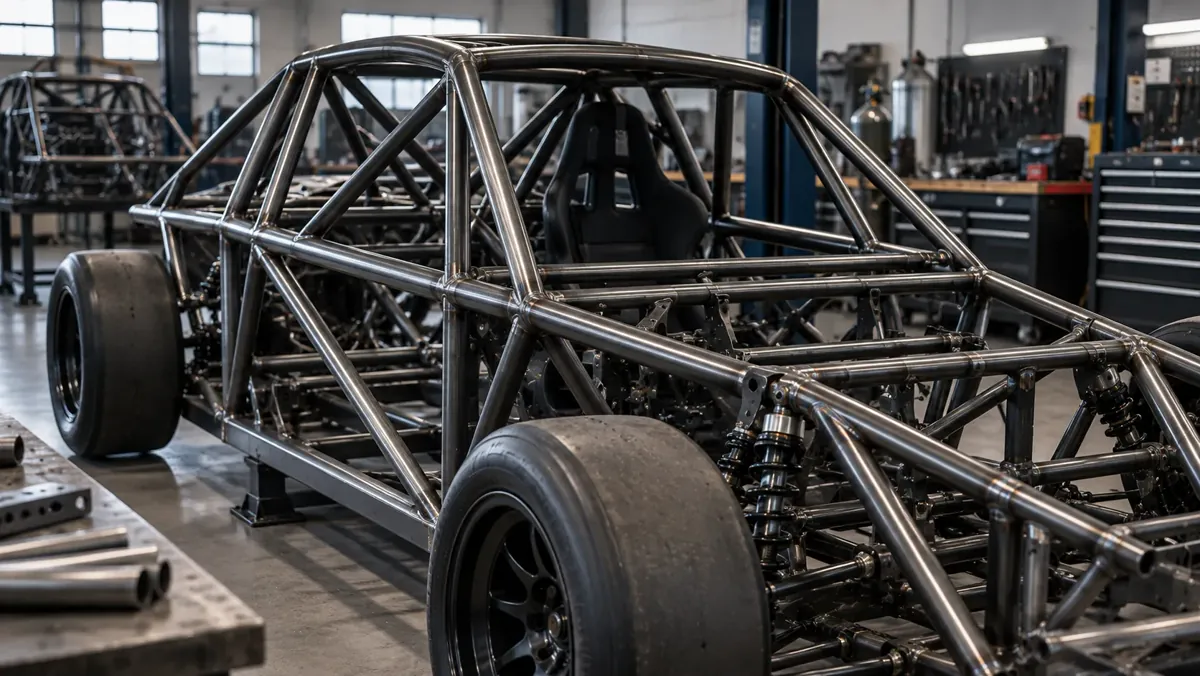
Primary Structural Systems
A typical circuit race car uses 4130 tubing in three overlapping structural systems:
1. The safety cage: Designed to the sanctioning body's roll cage rules. Non-negotiable in geometry, size, and material.
2. The chassis structure: The primary frame on which all suspension pickups, drivetrain mounts, and bodywork attach. Sized by the chassis designer based on torsional and bending load analysis.
3. Secondary structural members: Floor cross-members, seat mounting tubes, fuel cell cage, battery mount, and similar elements that support components and distribute loads.
Ordering Complete Tube Kits
Professional race teams and competent amateur builders often source tube in a single consolidated order rather than purchasing piecemeal. This approach: simplifies MTC documentation (fewer heat lots), reduces per-piece cost through volume, and ensures consistent material throughout the build.
| Build Component | Specification Requirement |
|---|---|
| Safety cage | Per rulebook — MTC required for tech inspection |
| Chassis frame rails | Per designer specification — confirmed by structural analysis |
| Suspension points | Engineering-analysed — OD and wall per load calculation |
| Secondary structure | Designer or builder determined |
| All elements | AISI 4130, Cold Drawn Seamless, MTC 3.1 |
Where 4130 Is Used on a Race Car
| Area | Typical 4130 use |
|---|---|
| Safety structure | Cage hoops, halo, door bars, braces |
| Chassis | Frame rails, bulkheads, diagonals |
| Suspension | Wishbones, links, pushrods, anti-roll bar arms |
| Steering | Column supports, tie rods |
| Mounts | Engine, gearbox, seat and pedal mounts |
| Bodywork supports | Light frames for body and wings |
A few areas call for something else. Parts next to the exhaust run hot and are better in stainless. Threaded adjusters are usually machined from bar and welded into the tube. Very highly loaded small parts may be made from heat-treated bar.
When you plan the material, list tube by area and size, add up the length of each size, and include an allowance for set-up and remakes. Ordering everything at once keeps the material consistent and the freight cost down. See 4130 tubing for racing and mixed size orders.
Frequently Asked Questions
Does the entire race car chassis need to be 4130, or just the cage?
Safety regulations specify 4130 for the roll cage (in classes where 4130 is required). The wider chassis structure may be 4130 or mild steel depending on the designer's choice and the applicable class regulations. Many builders use 4130 throughout for consistency, weight saving, and documentation simplicity.
Is 4130 used for race car suspension arms?
Yes. Wishbones, links and pushrods are common uses, in sizes matched to the loads.
Should exhaust-side parts be made from 4130?
Parts that run very hot are better made from stainless or a heat-resisting alloy.
Source 4130 Tubing for Race Car Build
Provide your complete tube list by structural system — cage, chassis, secondary — with OD, wall, and footage per size.
- Complete tube list: OD, wall, footage per size
- Sanctioning body (for cage compliance)
- MTC 3.1 required for all
- Delivery