
4130 Capillary Tubing
Capillary tubing is tube with a very small bore, used to carry tiny flows or transmit pressure. In 4130, the practical range starts far above the hair-fine sizes made in stainless steel and copper.
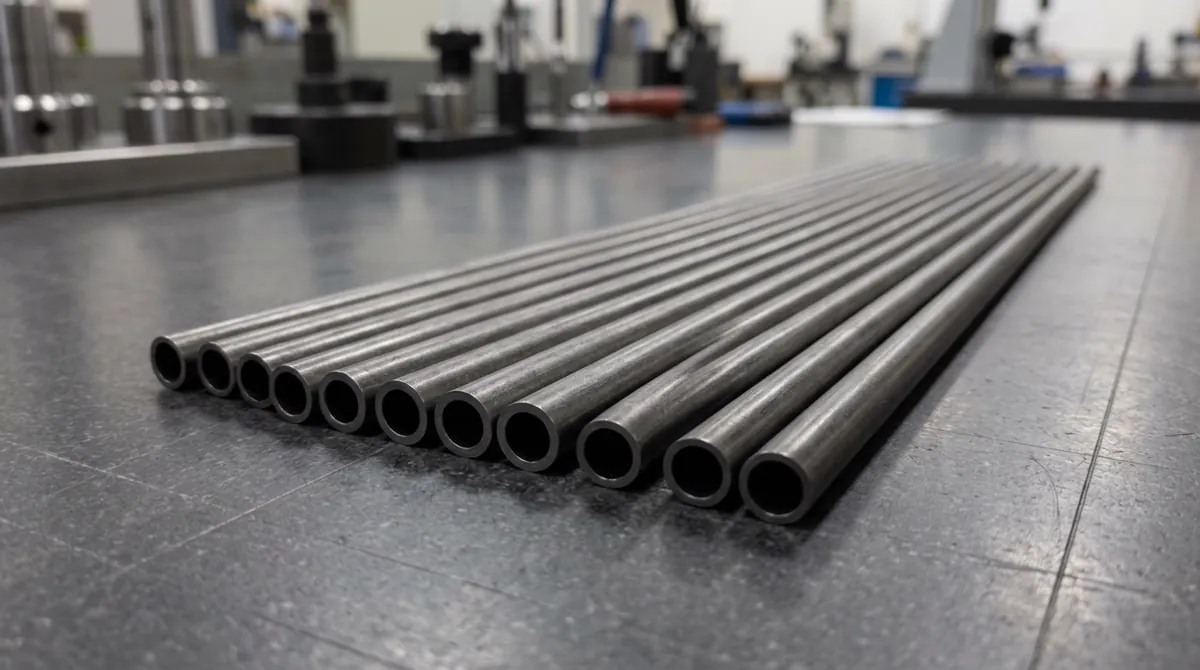
When 4130 is Appropriate for Capillary Applications
Most instrumentation capillary tubing is stainless steel (for corrosion resistance) or instrument steel with specific bore requirements. 4130 chromoly capillary tube is an uncommon product. If a capillary-range tube is required in 4130, this is likely because: a specific strength requirement at fine bore dimension is needed; or the application is within an existing 4130-alloy assembly and material consistency is required.
Buyers should submit an enquiry with the exact OD, wall, and bore requirements for a feasibility and availability assessment.
Specification for Very Small OD Tube
For small-diameter tube, dimensional tolerances become proportionally larger relative to the tube cross-section. Specifying the exact OD tolerance, wall tolerance, and bore smoothness requirements is essential for very small tube. The applicable standard and inspection requirements should also be explicitly stated.
| Parameter | Consideration for Capillary-Range Tube |
|---|---|
| OD range | Below approximately 0.25" — confirm availability at enquiry |
| Wall | Very thin walls — confirm minimum wall feasibility |
| Tolerance | Must be explicitly specified — tighter than standard may be needed |
| Material | 4130 alloy — confirm application suitability |
| Standard | State applicable standard or tolerance class explicitly |
Working With Small-Bore 4130
Fine tube needs gentle handling. It kinks if bent by hand over a small radius, so use a former or a small bender, and keep it supported in storage so it does not take a set.
Cutting is the usual cause of trouble. A saw or abrasive wheel leaves a burr that partly closes a small bore and sheds particles into the line. Cut with a fine blade or a tube cutter suited to the hardness, then deburr inside and out and flush the tube. Because 4130 rusts, a small-bore line must be kept dry inside or filled with a protective fluid; once rust forms in a fine bore it is almost impossible to remove. If you need very small diameters, or corrosion resistance, stainless capillary tube is the appropriate product. For the smallest regular 4130 sizes see small diameter tubing; for instrument connections see instrumentation tubing.
Frequently Asked Questions
Is stainless steel typically used instead of 4130 for capillary applications?
Yes, in most instrumentation and medical capillary applications, stainless steel (e.g., 316SS) is standard due to its corrosion resistance. 4130 capillary tube would be a specialist requirement.
What is the smallest 4130 tube size?
Regular supply begins at about 0.250" OD. Much finer sizes are not normally made in this alloy.
How should small 4130 tube be cut?
With a fine blade or suitable tube cutter, followed by deburring and flushing to clear the bore.
Is 4130 a good choice for capillary lines?
Rarely. Stainless or copper capillary tube is usual, because 4130 rusts and is not made in very fine sizes.
Enquire About Small-OD 4130 Tube
Provide your exact OD, wall, bore, tolerance, and standard requirements for a feasibility assessment.
- OD (in inches or mm)
- Wall Thickness
- Bore dimension required
- Tolerance class
- Standard or Specification
- Quantity