
4130 Instrumentation Tubing
Instrumentation tubing connects gauges, transmitters and control devices to a process. It is small, has to seal reliably in compression fittings and must not contaminate the instrument, which makes material choice more exacting than the size suggests.
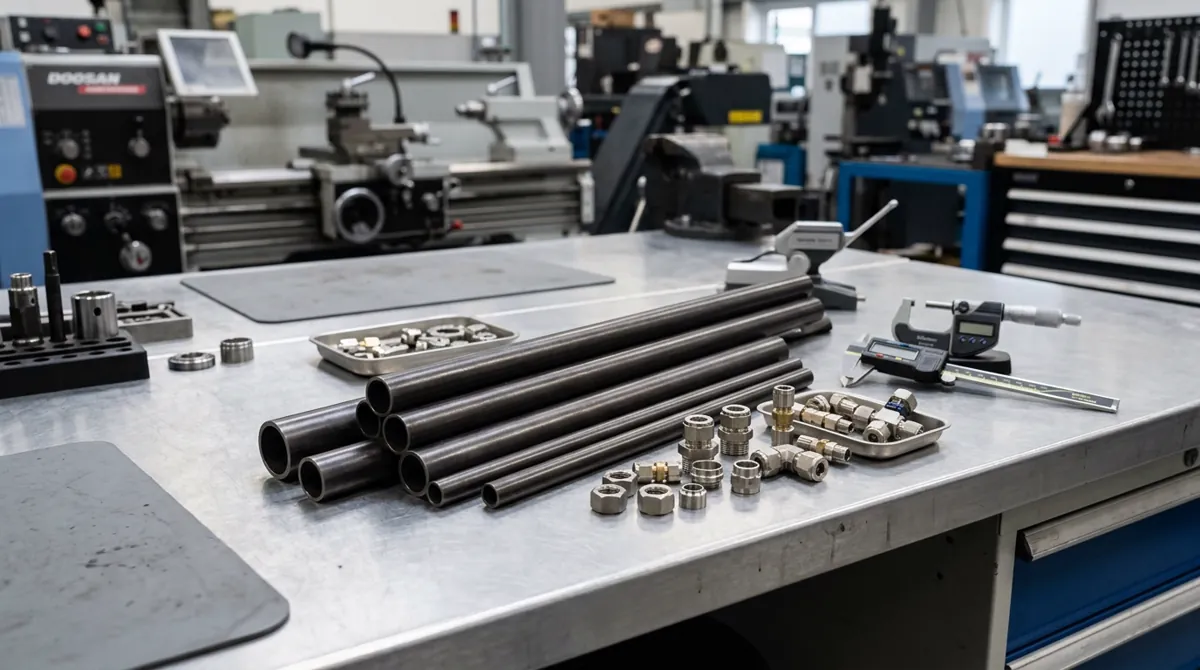
Specification for Instrumentation Use
Instrumentation tubing requires especially tight dimensional control. The OD must be consistent for fitting compatibility (instrumentation fittings are designed to specific OD tolerances). Wall thickness must be uniform to ensure consistent pressure capacity. Surface finish of the bore may be important for certain measurement applications.
For 4130 instrumentation tubing, specify: exact OD with tolerance class, wall thickness with tolerance, applicable standard, condition, surface finish if relevant, and MTC documentation.
| Instrumentation Parameter | Specification Requirement |
|---|---|
| OD | Exact nominal + tolerance class — fitting compatibility critical |
| Wall | Minimum wall for system pressure — plus tolerance |
| Surface finish | Specify if bore cleanliness is critical |
| Condition | Typically as-drawn CDS or normalized |
| Standard | Applicable specification — state explicitly |
| MTC | EN 10204 3.1 or as required by quality plan |
Stainless vs. 4130 for Instrumentation
In most general process instrumentation, stainless steel (316L or similar) is standard due to its corrosion resistance in fluid measurement lines. 4130 alloy is appropriate for instrumentation within high-strength structural systems — such as aircraft instrument lines within a 4130 airframe structure — where the same alloy family is specified throughout for consistency and the environment is controlled.
Hardness, Fittings and Cleanliness
Twin-ferrule compression fittings work by the ferrule biting into the tube. For that to happen the tube must be softer than the ferrule, and fitting manufacturers publish a maximum tube hardness. Annealed stainless and annealed carbon steel tube are made to stay under it. Normalized 4130 is harder, so it may not seal properly; if 4130 must be used, order it annealed and confirm the hardness against the fitting maker's limit.
Corrosion is the other issue. Instrument lines are small bore, so a little rust can block or contaminate them. 4130 has no corrosion resistance and needs a protected, dry system. For most instrument duties stainless tube is the practical choice, with 4130 reserved for cases where high strength in a small section is the priority, such as mechanical linkages in instrument assemblies. See capillary tubing and small diameter tubing.
Frequently Asked Questions
What fitting standards are compatible with 4130 instrumentation tubing?
Compression fittings (e.g., Swagelok, Parker, or equivalent) are designed to specific OD tolerances. Confirm that the 4130 tubing OD tolerance is compatible with the fitting specification before ordering. The fitting manufacturer's dimensional requirements should be consulted.
Will compression fittings seal on 4130 tube?
Only if the tube is soft enough. Check the fitting manufacturer's maximum tube hardness and order annealed tube.
Why is stainless preferred for instrument lines?
It resists corrosion, stays clean and is supplied in a soft annealed condition suited to compression fittings.
What sizes are instrument lines?
Commonly 1/4" to 1/2" OD, in walls chosen for the pressure.
Enquire for 4130 Instrumentation Tubing
Provide OD with tolerance, wall, condition, fitting compatibility requirement, and MTC for a precision tubing quotation.
- OD + tolerance class
- Wall thickness + tolerance
- Applicable fitting standard (if relevant)
- Condition
- Standard
- Quantity
- MTC
- Delivery