
4130 Cold Drawn Tubing
Cold drawing pulls a tube through a die at room temperature to bring it to its final size. For 4130 it is the process that produces the accurate, smooth, thin-walled tube used in frames, cages and aircraft.
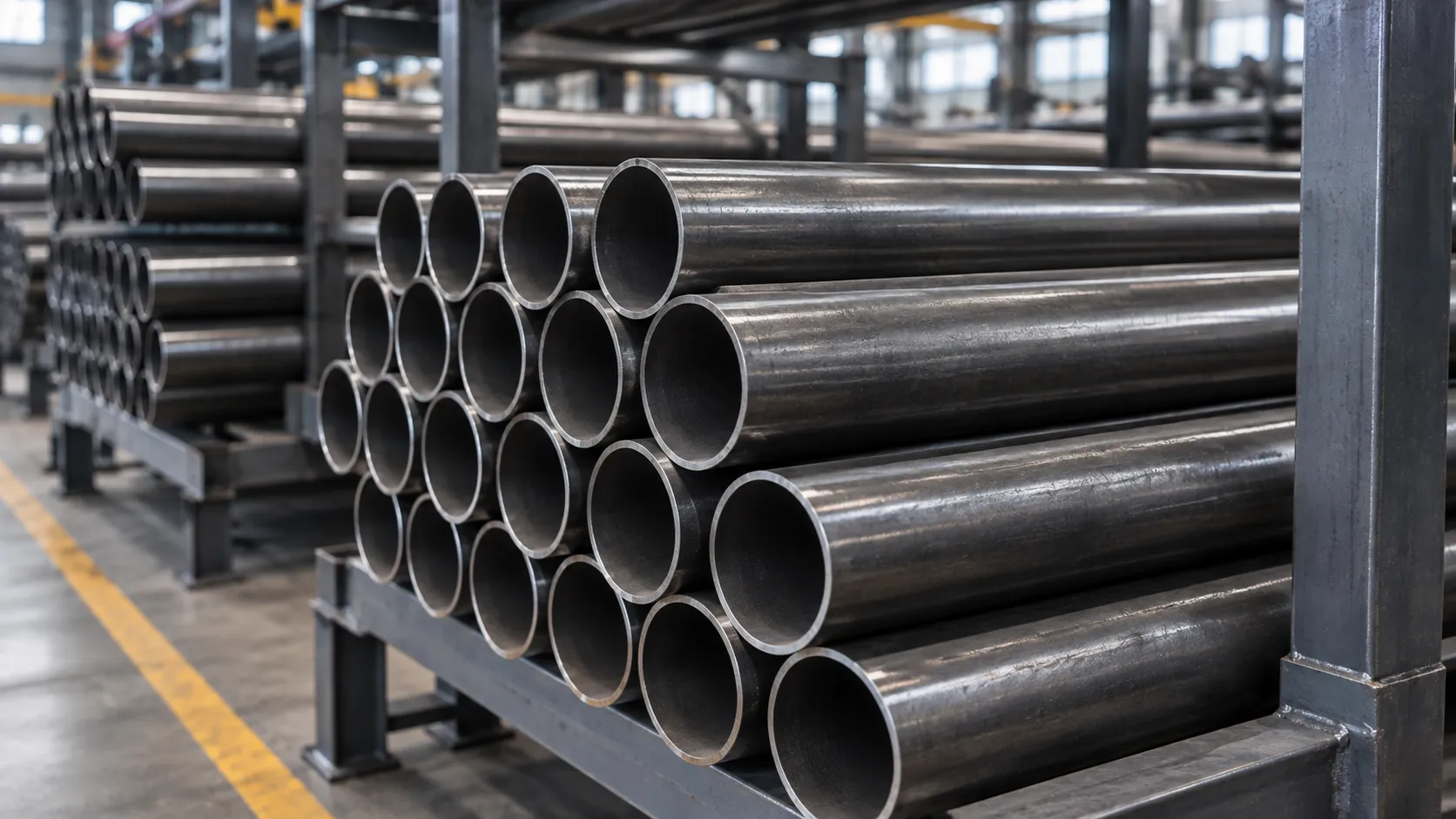
Cold Drawing Process Benefits
Cold drawing provides several benefits relevant to 4130 procurement:
1. Dimensional accuracy: CDS tolerances are tighter than Hot Finished Seamless (HFS). Per ASTM A519, CDS OD tolerances are typically within ±0.5% of nominal OD for common sizes.
2. Surface finish: The bright, clean surface is free of mill scale. This is important for TIG welding quality — scale on the tube surface requires removal before welding, adding labour cost.
3. Work hardening: The cold drawing process adds a modest increase in yield and tensile strength compared to the normalised equivalent. However, for aerospace applications, the material is typically subsequently normalised or annealed to achieve a defined, predictable condition.
4. Concentricity: The CDS process improves wall thickness uniformity around the circumference, important for precision machined components.
| Parameter | Cold Drawn Seamless (CDS) | Hot Finished Seamless (HFS) |
|---|---|---|
| Surface | Bright, scale-free | Scaled / oxidised |
| OD tolerance (typical) | ±0.5% or tighter | Broader |
| Wall concentricity | Improved by drawing | Less precise |
| Work hardening | Present (unless annealed) | Absent |
| Weld prep | Minimal prep required | Scale removal required |
| Typical standard | ASTM A519 (CDS section) | ASTM A519 (HFS section) |
When CDS is Required
Cold Drawn Seamless should be specified when: the application requires precise OD and wall control (aviation spars, precision machined parts); the surface finish is important for weld quality or appearance; or the applicable specification (e.g., AMS-T-6736) mandates the cold drawn form. For most structural and aerospace 4130 applications, CDS is the appropriate and standard form.
Delivery Conditions After Drawing
Drawing hardens the steel, so what happens after the last pass matters as much as the drawing itself. Tube can be supplied:
- As-drawn. Hard and strong with low ductility; rarely suitable for bending or welded structures.
- Stress relieved. Drawing stresses reduced, most of the strength kept.
- Annealed. Fully softened for machining and forming.
- Normalized. Uniform structure and the usual choice for welded fabrication.
State the condition on every order. A tube described only as "cold drawn" tells you how the size was achieved, not what state the metal is in. Cold drawn 4130 is generally available from about 0.250" OD up to the mid-size range, with walls from 0.035"; larger and heavier sizes are usually hot finished. See normalized tubing for the standard structural condition.
Frequently Asked Questions
Does cold drawing change the mechanical properties of 4130?
Cold drawing work-hardens the material, which modestly increases yield and tensile strength but reduces ductility compared to the annealed condition. For applications requiring a specific mechanical property profile (e.g., Normalized), the tubing is typically heat treated after cold drawing to achieve the specified condition.
What does 'as-drawn' mean on a specification?
'As-drawn' or 'as-cold-drawn' means the tubing is supplied without post-draw heat treatment. The mechanical properties reflect the cold-worked state. For most structural fabrication, as-drawn CDS 4130 is adequate. For aerospace applications, a specified heat treatment condition (Normalized) is usually required.
Is cold drawn 4130 always normalized?
No. Normalizing is a separate heat treatment after drawing and has to be specified.
What surface finish does cold drawn tube have?
A smooth, bright surface inside and out, free from the scale found on hot finished tube.
Source 4130 Cold Drawn Seamless Tubing
Specify your required OD, wall, condition, and standard for a CDS 4130 quotation.
- OD and Wall
- Condition (As-drawn, Normalized, Annealed)
- Applicable Standard
- Footage / Tonnage
- MTC Requirement
- Delivery Location