
4130 Elliptical Tubing
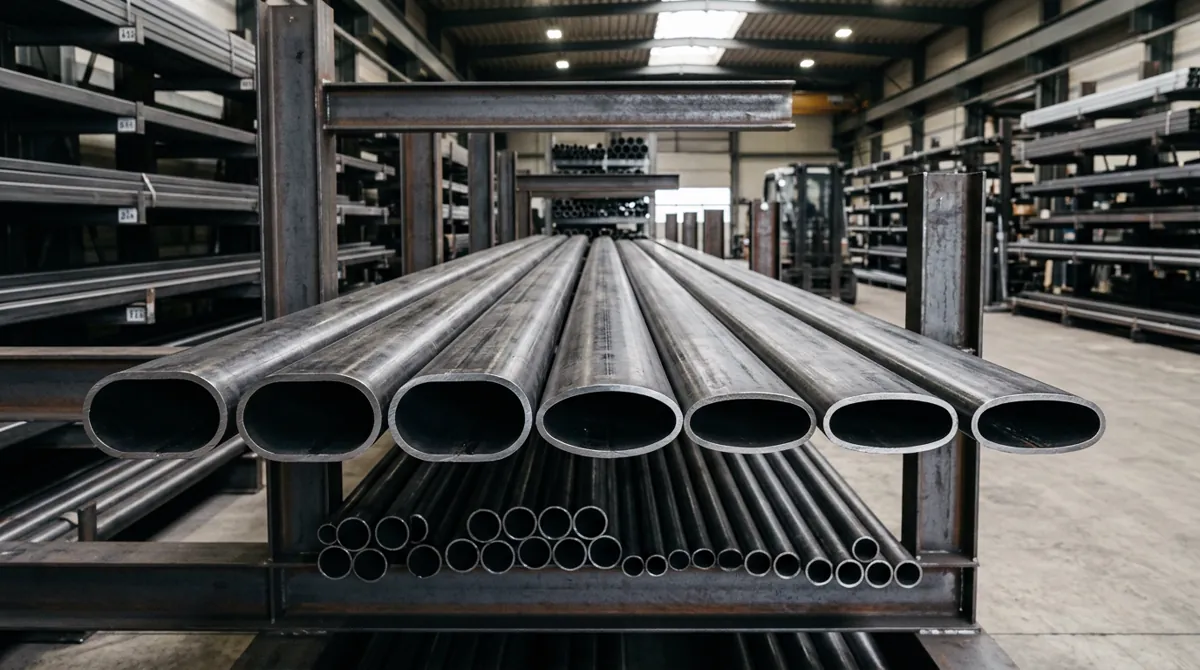
Elliptical 4130 tube is normally made by reshaping round tube, either at a mill for larger quantities or in the workshop for a few pieces. The geometry is simple enough to plan in advance.
Commercial Availability in 4130
Elliptical hollow sections are produced commercially in mild steel and aluminium for architectural, furniture, and lightweight transport applications. They are not manufactured in 4130 chromoly alloy as standard products. The seamless manufacturing route for 4130 — billet piercing and die drawing — produces circular cross-sections. Non-circular sections require different tooling and are only viable for dedicated production runs with appropriate minimum quantities.
| Parameter | Standard 4130 Tube | Elliptical in 4130 |
|---|---|---|
| Cross-section | Circular | Non-standard |
| Commercial availability | Yes — stock product | No — requires custom enquiry |
| Manufacturing route | Seamless (CDS) | Not applicable as standard |
| Recommended action | Specify OD and wall | Design review and custom enquiry |
Estimating the Starting Tube
When a round tube is pressed or rolled into an ellipse, its perimeter stays almost the same. So the circumference of the round tube, which is pi times its diameter, must equal the perimeter of the ellipse you want. As a working approximation, the starting diameter is a little more than the average of the major and minor axes; for example an ellipse of roughly 1.75" by 1.00" comes from a tube of about 1.40" diameter. Make a trial piece before committing material.
The wall does not change much, but the flatter sides lose stiffness against denting. Very flat ellipses risk wrinkling on the long sides unless the tube is supported inside. Ovalise in the normalized or annealed condition, never as-drawn. For aircraft and similar critical parts, use purpose-made streamline tube instead of home-formed sections; see oval tubing.
Frequently Asked Questions
Why isn't 4130 produced in elliptical cross-section?
The seamless tube manufacturing process naturally produces circular cross-sections through die drawing. Producing an elliptical cross-section requires different tooling (shaped dies and mandrels) and is only commercially viable for dedicated production runs. The market demand for elliptical 4130 is insufficient to support standard commercial production.
Can I make elliptical tube from round 4130 tube?
Yes, by pressing or rolling in suitable dies. Make a trial piece first and keep the ellipse moderate.
Does ovalising weaken the tube?
It changes the stiffness: higher along the long axis, lower along the short axis. The material itself is unaffected if forming is done properly.
How do I specify an elliptical tube?
Give the major and minor axis dimensions, the wall, the length and the quantity.
Can an elliptical tube be bent?
It can, but only with tooling that supports the section, and more easily about its minor axis.
Which condition should tube be in for ovalising?
Normalized or annealed. As-drawn tube is too hard and may crack.
Discuss Your Non-Standard Requirement
Contact us with your elliptical cross-section application details for a feasibility and availability discussion.
- Major and minor axis dimensions
- Wall thickness
- Application
- Quantity and timeline