
4130 Chromoly for Condenser Tubing
Condenser tubes carry cooling water on one side and vapour on the other. The duty calls for corrosion resistance and good heat transfer in a thin wall, which are not the strengths of 4130.
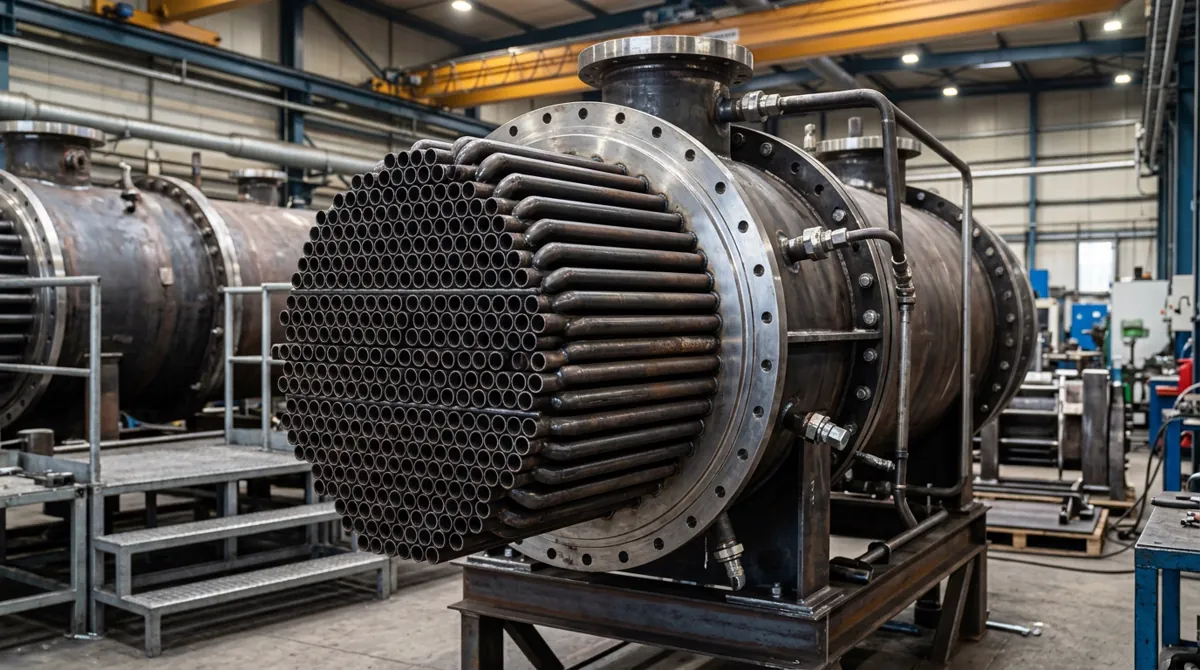
Is 4130 Suitable for Condenser Tubing?
Condensers require tubing with excellent corrosion resistance and thermal conductivity to handle cooling water, seawater, or chemical refrigerants. Copper-nickel, titanium, and specific stainless steels are standard.
4130 has poor corrosion resistance and will rapidly corrode if exposed to cooling water or condensation. It is a structural alloy, not a heat-transfer or corrosion-resistant alloy, making it unsuitable for condenser applications.
What to Specify for Condenser and Heat Exchanger Tubes
Tube material is chosen mainly by the cooling water. Clean fresh water permits carbon steel; brackish and sea water call for copper alloys, stainless steels or titanium. The tubes are made to heat exchanger standards with tight tolerances and a pressure test on every length.
| Water or duty | Tube materials normally used |
|---|---|
| Closed or treated fresh water | Carbon steel to ASTM A179 |
| General water service | Stainless steel to ASTM A213 or A249 |
| Sea water and brackish water | Copper-nickel and other copper alloys, titanium |
4130 rusts in water and offers no advantage in heat transfer. It may appear in the mechanical parts of a condenser, such as supports or tie components, but not as tube bundle material. The related case of finned tubing is assessed separately.
Where Strong Steel Is Used in a Condenser
A condenser is more than its tube bundle. The shell, supports, saddles and lifting points are structural items, and the tie rods and spacers that hold the baffles in position are mechanical parts. These are normally made from carbon steel to the vessel code. Low alloy steel is considered only where a designer needs higher strength in a specific component, and the material must then be one the applicable code permits.
Frequently Asked Questions
Can 4130 be used for condenser tubes?
It is not suitable. It corrodes in cooling water and is not produced to heat exchanger tube standards.
What is the usual carbon steel condenser tube standard?
ASTM A179, which covers seamless cold drawn low carbon steel heat exchanger and condenser tubes.
Does Siddhgiri Overseas supply condenser tubes in 4130?
No. 4130 is supplied as mechanical and structural tubing. For condenser duty the correct material should be specified.
What decides the tube material in a condenser?
Mainly the cooling water chemistry, followed by temperature, pressure and cost.
Are condenser tubes pressure tested?
Yes. Heat exchanger tube standards require each length to be hydrostatically or non-destructively tested.
Why are copper alloys used in sea water condensers?
They resist sea water corrosion and conduct heat well.
Enquire for 4130 Mechanical Tubing
If your engineering assessment confirms 4130 mechanical tubing is suitable for your application, provide your OD and wall requirements.
- OD & Wall
- Standard (ASTM A519)
- Application description
- MTC requirement