
4130 Chromoly for Radiant Tubing
Radiant tubes sit inside a furnace and run red hot while a burner fires through them. They need to resist oxidation and keep their shape for years at temperatures far above anything a low alloy steel can stand.
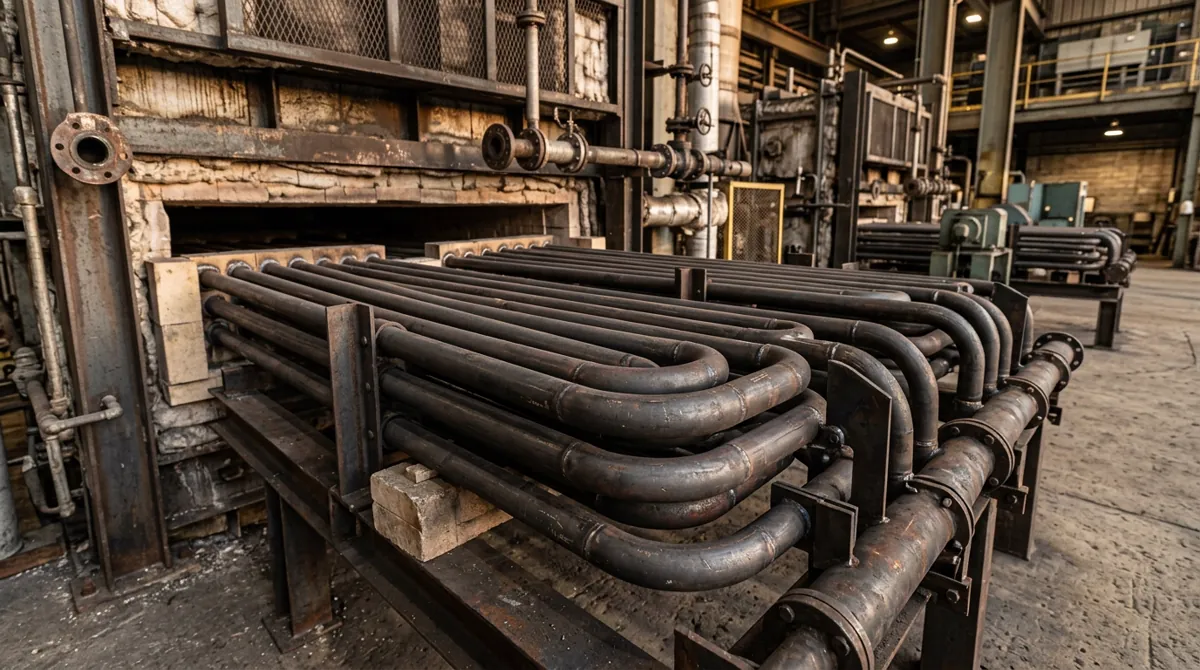
Is 4130 Suitable for Radiant Tubing?
Radiant tubes in furnaces operate at extremely high temperatures (often exceeding 800°C / 1500°F) and require alloys with high-temperature creep resistance and oxidation resistance, such as Inconel or high-nickel stainless steels.
4130 is a low-alloy steel. At radiant furnace temperatures, 4130 will rapidly lose its structural strength and suffer from severe scaling and oxidation. It is entirely unsuitable for high-temperature radiant tube applications.
What to Specify for Radiant Tubes
Furnace radiant tubes are made from heat-resistant alloys with high chromium and nickel contents, either wrought or centrifugally cast. These alloys form a stable protective oxide and retain strength at furnace temperatures.
| Material family | Typical use |
|---|---|
| Heat-resistant stainless steels such as 309 and 310 | Moderate furnace temperatures |
| Nickel-chromium alloys such as alloy 601 | Higher temperatures and carburising atmospheres |
| Cast heat-resistant alloys such as HK and HP types | Heavy-duty industrial furnace tubes |
4130 contains about 1 percent chromium, which is far too little to protect it. It would scale heavily, sag and fail quickly. Its general temperature limits are discussed on the heat resistant tubing page.
Where Low Alloy Steel Is Used Around Furnaces
Steels like 4130 do have a place in furnace equipment, outside the hot zone. Charging machinery, door mechanisms, conveyor frames, handling tools and the supporting structure all run at moderate temperatures and benefit from a strong, weldable tube. The dividing line is temperature and atmosphere: anything exposed to the furnace interior needs a heat-resistant alloy, and anything kept cool can be structural steel.
Frequently Asked Questions
Can 4130 be used for furnace radiant tubes?
No. It lacks the oxidation resistance and high-temperature strength the duty requires.
What temperature can 4130 tubing withstand?
It is a structural steel intended for use at ordinary temperatures. It loses strength and scales as temperature rises, so it is not selected for furnace service.
Can 4130 be used elsewhere on a furnace?
Yes, for structural and mechanical parts outside the hot zone.
What information does a radiant tube supplier need?
The furnace temperature, atmosphere, tube shape and dimensions, and how the tube is supported.
Why do radiant tubes fail?
Usually from oxidation, creep sagging, carburisation or thermal fatigue after long service at high temperature.
Does the chromium in 4130 make it oxidation resistant?
No. About 1 percent chromium is far too little. Heat-resistant alloys contain 20 percent or more.
Can I get help choosing the right standard for furnace tube?
A furnace builder or heat-resistant alloy supplier is the right source for that selection.
Enquire for 4130 Mechanical Tubing
If your engineering assessment confirms 4130 mechanical tubing is suitable for your application, provide your OD and wall requirements.
- OD & Wall
- Standard (ASTM A519)
- Application description
- MTC requirement